



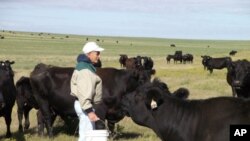
There’s a chill in the air as high plains winds beat against the walls of Assumption Abbey. The Benedictine monastery stands like a great stone fortress at the edge of the small town of Richardton, North Dakota.
Inside, sounds of the daily activities of 25 monks - singing, prayer and conversation - fill the air. There are also sounds not usually associated with the Catholic Church.
The monks care for 300 head of cattle, descendants of animals brought here when the monastery was built more than a century ago.
Brother Placid Gross has been the main wrangler for the black Angus herd almost since he arrived at the abbey in 1957.
“The monks came here, started a monastery here in 1899 and they’ve had a farm right from the beginning. It was a way of raising our own food," he says. "In the early days, everybody had beef cattle and dairy cattle. But now, in recent years, we’re selling most of the cows or the calves. We still butcher our own, but we don’t butcher very many. So, it is a source of income for the abbey.”
Selling off
It’s a source of income that’s about to disappear. The monks are preparing to sell their herd at auction, probably in late November.
Abbot Brian Wangler, who’s in charge at the monastery, says it’s strictly a matter of manpower.
“It’s people willing to do the work, knowing how to do the work. It almost requires somebody who was raised on a farm. I mean, you can learn the work, but you’ve really got to have an interest in it. And we just don’t have enough young people who are really interested in that kind of work.”
Not just interested in that kind of work, but such a person would also have to be willing to live the life of a monk, which includes group prayer sessions four times a day.
At 76, Brother Placid finds handling the cattle herd, with just one 40-something fellow monk, a bit taxing.
“The hardest part of the work is the calving time. Very often we get really bad weather. You have to be out there to help bring the calf inside to a warm place. So we get up during the night. We check at least every four hours.”
Rancher shortage
A shortage of young ranchers isn't just a problem for the monks in North Dakota.
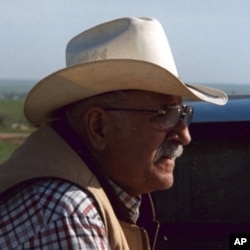
“We’ve got the average age of the farmer/rancher in the Upper Great Plains as 58-years old," says cattleman Marv Kammerer, who attended a recent meeting of the Stockgrowers Association in Rapid City, South Dakota. "And that’s dangerous for the economy and the industry.”
Kammerer feels fortunate that five of his seven children followed him into ranching, but says that’s not the norm.
“There’s a lot of things drawing the young people away from the ranches and farms. They’re going for better wages, schools, otherwise a lot of economic factors drive them off these places.”
Losing the family business
The number of cattle operations in South Dakota has dropped by more than 13,000 since 1980, according to R-CALF USA, a national stockgrowers association.
Nationwide, more than 147,000 cattle operations have gone out of business in the past 15 years.
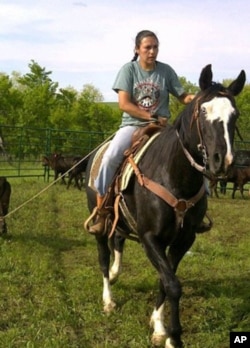
Alex Romero-Frederick, who runs a small ranch on the Rosebud Sioux Reservation with her husband, feels the squeeze.
“We’re losing the family ranching business," she says. "The next generation takes over after the other generation retires and I’m not seeing that anymore. And it’s kind of scary. I mean, are my kids going to do it? Did I instill in them the right stuff to want to take over after I’m gone?”
Whether at a North Dakota abbey or on ranches in South Dakota, Kammerer believes the gifts of raising cattle - providing food and caring for the land - should be relished. He hopes they’re gifts the next generation will choose to accept.