



For many years millions of people around the world have been fed by genetically-modified crops. Soon, some food animals will be genetically-modified as well, to be larger and grow more efficiently to feed a rapidly growing population.
At a laboratory in Rhode Island, rainbow trout much larger than usual are already being produced.
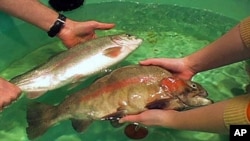
The two rainbow trout (pictured above) are the same age and were raised in the same tank. But the larger one has been genetically modified.
"You can see this enhanced muscling and these are the parent stock," Professor Terry Bradley explained. Bradley leads the research at [the Department of fisheries and veterinary science at] the University of Rhode Island. "The other fish on the bottom, you can see it doesn't have the increased muscle mass. So we know this fish has about 20 percent more muscle mass than the standard fish has."
The process starts in a laboratory. Over the last four years, Dr. Bradley has injected 20,000 rainbow trout eggs with a DNA variation which inhibits a protein that restricts muscle growth.
"Each egg and the micro pump is set to deliver 5 nano-liters of DNA which you cannot see it. We put dye in it, so all you see is this tiny little dot inside the egg, of green food coloring, and that's the only way you know it has been injected," he said.
In a normal-sized trout, a genetically-controlled protein called "Myostatin" keeps the fish from growing beyond a certain size.
Dr. Bradley's research shows that altering the gene that produces Myostatin seems to result in more muscle mass
"We inject them into the egg, so each egg gets injected with a little bit of DNA," he says, "and if you get lucky a bit of that gets incorporated into the genome of the developing embryo and that develops into a fish."
Once the eggs hatch they start their journey through a series of tanks in this aquaculture research facility. But from all the thousands of injected eggs, only 300 fish so far have carried the modified gene.
The research will continue for a few more years before a larger and more efficiently-growing rainbow trout can move on to the commercial markets. Bradley says the final goal is to increase the overall efficiency of aquaculture.
"For example where it typically may take 1.2 kilogram of feed to produce one kilogram of fish we hope that by inhibiting Myostatin we hope that one kilogram of food will produce one kilogram of fish," Bradley said.
Professor Bradley's study has been funded by the U.S. Department of Agriculture.
"The purpose of understanding muscle growth would be, first, to produce that muscle in a more efficient and more sustainable manner, that is to produce more meet for consumption with less input of resources, less energy, less feed, less labor input," stated Mark Mirando, who is with the Department's National Institute of Food and Agriculture.
And perhaps, he says, with better taste or more nutrients. Worldwide, the fish most commonly produced through aquaculture are catfish and tilapia, both freshwater species. But salmonid species like salmon and trout are rapidly becoming more popular in the industry.
The U.S. Department of Agriculture says the value of aquaculture production rose to nearly $1 billion in the U.S.over the past 20 years, mostly due to growing demand for fish in general and harvesting restrictions on wild fish.
Mirando says the rapid growth of aquaculture is linked to population growth.
"The demand for seafood in the U.S. and worldwide is rapidly increasing but the ability of the oceans to supply that food, even at the current levels, disregarding population increases and increases in demand; the ability of the oceans to supply that is diminishing," Mirando said.
Mirando dismisses concerns about genetic modifications, pointing out that humans have already genetically modified many plants and animals through centuries of selective breeding. The most common examples, he says, are dogs, which range in size from Chihuahuas to great Danes.