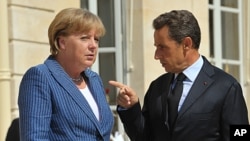


Economic growth in Germany slowed dramatically between April and June, according to figures published Tuesday. The news comes as Germany's leader Angela Merkel geared up for talks with Nicolas Sarkozy of France over how to shore up the struggling eurozone.
Germany says its economy grew by 0.1 percent in the second quarter - much slower than expected.
The director of trade at Close Brothers Seydler Bank in Frankfurt, Oliver Roth, says it is not good news. He says the fact that the German GDP was lower than expected means worries will grow that an economic crisis will come on top of the debt crisis.
Sovereign debt was to top the agenda at a meeting between Germany Chancellor Angela Merkel and French President Nicolas Sarkozy.
One solution to the debt problem proposed by some is “eurobonds” to be issued to investors that are backed by the whole eurozone, not just by individual countries. So far, Germany has rejected the plan.
Roth says he hopes it stays that way. He says he hopes Merkel stands firm on eurobonds, because he believes they would calm the markets in the short-term, but in the long run would poison them.
Three eurozone countries have been bailed out by their euro neighbors in order to avoid defaulting on their debts. Some fear Italy and Spain could be heading in the same direction, and last week investors dumped shares in French banks amid fears the country's credit rating was about to be downgraded.
Analysts say the big risk is that the debt crisis, which began with periphery countries, is now striking at the very heart of the eurozone.
Billionaire investor George Soros says the unraveling of the eurozone could be on the horizon unless major changes take place. Speaking on the BBC, he says “eurobonds” are the best way forward.
"You have to make the euro work, and for that debtor countries Spain and Italy must be able to refinance their national debt at reasonable rates, and the best way to do that is with eurobonds," he said.
Germany is not the only European country whose economy is struggling; overall the eurozone posted 0.2 percent growth in the second quarter, that is down from 0.8 percent in the first quarter.
German Economy Slows