




Todd Casey is the owner-operator of MeTompkin Bay Oyster Company and he's got a major problem, no oysters.
Casey's family-run business is located on Maryland's eastern Atlantic shore.
The oil spill in the Gulf of Mexico, a thousand kilometers away, cut off his main supply of oysters since April, shutting down his entire summer shucking operation.
He doesn't expect to start it up again until October when Maryland's local oyster season begins. "Oysters are probably 30-40 percent of what we do. The other 60 percent are crab, soft crabs and crab meat."
Lingering problem
Seventy percent of the oysters Americans consume come from the Gulf of Mexico.
Casey says that economy is intimately tied to his own. "We sell product down there. They sell product up here. When their restaurants don't buy, their vacation season is cut short and people don't come to the beach, it effects our sales down there, and likewise they don't have anything to ship up here."
At the height of the oil spill disaster, approximately 37 percent of federally-managed Gulf waters were closed to fishing. By mid-August that was down to 22 percent.
Casey remains cautious, waiting for signals from the Food and Drug Administration.
In a recent government hearing FDA senior food safety official Donald Kraemer address concerns from MeTompkin testifying that the FDA bases any decision to reopen fisheries on monitoring data. "We are able to vouch for the safety of those fish with respect to the contamination from the spill." Bill Lehr, senior scientist with the National Oceanic and Atmospheric Administration or NOAA agreed that "the fish caught is meeting all the standards that were developed by FDA and NOAA."
That level of security resonates with oyster farmer Mike Voisin, who came to testify from Houma, Louisiana where his family-run company harvests between 45 and 75 million oysters a year.
"In open waters where fish are being harvested commercially I would feed it to my kids and to my wife. And we do eat it often."
But getting the industry back on its feet will mean winning over the American public as well. In recent weeks conflicting reports from government officials and scientific experts have left consumers confused.

Continued uncertainty
That uncertainty permeates a bustling open-air fish market not far from the U.S. Capitol. Under bright red and blue awnings vendors market a wide variety of fresh fish and serve up fresh oysters and steamed shrimp to passersby.
Ryan Evans, whose family has run Jessie Taylor Seafood on this wharf for over 70 years, says although some Gulf fisheries have opened, he isn't buying.
"No, I haven't yet basically because I'd like to give it a little more time to make sure that everything is okay. I'm really not that comfortable telling my customers that something was coming out of the Gulf right now. I want to be as honest with them as possible."
For now he buys seafood elsewhere at higher prices and is not passing on the price hike to consumers. "I'm just trying to hang on. I'm really not making any money at it. I'm trying to survive."
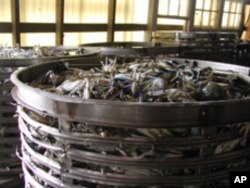
Teloria and Abraham Odon are his loyal customers. They've just bought a half-bushel of local crabs and some fish. While both have a healthy appetite for seafood, they differ over whether to eat seafood from the Gulf.
Concerns about Gulf Seafood
"I am still questionable about that, Mrs. Odon says. "If I thought the seafood came from the Gulf, I might not eat it." Her husband says he would probably eat a small amount.
Nearby, devouring a plate of fresh oysters, are Michael and Janet Johnson, visiting from Henderson, North Carolina.
Unlike Teloria Odom, the Johnsons wouldn't hesitate to buy Gulf seafood. "If they are saying it is safe to eat, then I'll go with the government," Mr. Johnson says.
His wife shakes her head in agreement, "I don't have any concerns. My concerns are for the people down in the Gulf. That's where my concerns go. It's really on the economy."
But doubts about the safety of Gulf seafood linger on Capitol Hill, along with equally urgent concerns about the long-term environmental and public health effects of the massive oil spill, and the chemical dispersants used to hasten its cleanup.