


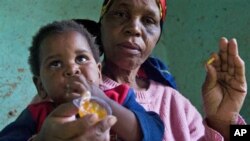
The World Food Program says there is growing evidence that food and good nutrition helps people with HIV stay healthy and improve the effectiveness of treatment. WFP, supported by the Joint U.N. program on HIV/AIDS, is launching a new policy to make food and nutritional support more available to people living with HIV.
HIV/AIDS often is described as the wasting disease. That is because people who are infected with HIV are at high risk of losing weight and becoming malnourished. They are at risk of disease and are vulnerable to getting tuberculosis and dying.
UNAIDS reports an estimated 2.6 million people were newly infected with HIV last year. It says more than 33 million people are living with HIV, many of them thanks to anti-retroviral therapy.
But, the World Food Program argues anti-retroviral therapy alone is not enough to keep people healthy and alive. WFP's head of Nutrition and HIV, Martin Bloem says food and nutritional support are vital components of this medical treatment.
He says people who do not have access to food find it difficult to take anti-retroviral drugs. He says patients often suffer unpleasant side effects and the risk of their going off treatment rises.
"We have seen that when you put people on treatment in most less developed countries, that the effectiveness of the treatment is not the same as if you start the treatment in the U.S. or in Europe, for example. So people have about two to six times higher mortality…in the first couple of months, when they start treatment."
What makes the crucial difference, says Bloem, is access to proper nutrition. He explains HIV patients in wealthy countries get the food they need to keep them healthy and alive, which often is not the case in the poor countries.
He says malnourished people are at greater risk of dying from HIV. Therefore, he says it is essential they regain the weight they have lost. He says the patient needs to consume a nutritious diet that helps to rebuild the tissues, the fat mass and muscles that were lost.
He says WFP's new strategy has several different elements. The first he says is to provide HIV patients with adequate nutrition to make their treatment as effective as possible.
"The purpose in the first couple of weeks and months is to make the person as healthy as possible," he said. "So, you need what we call the most nutrient dense food affordable and available for people who are adults. At this particular moment, we do not have those particular products. So, what we have done is to look into the products, which are available now for children who are severely malnourished. And, those products are available for us to give to adults."
Another important component of WFP's new policy is to provide social safety nets to households of people who have HIV. Under the plan, these families may receive food rations, cash transfers or vouchers that would allow them to purchase food at local markets.
WFP says the aim of this program is to help patients stick to their treatment, while protecting their households from further vulnerability.