




Indians call the eggplant the "king of vegetables". It's a popular ingredient in many native dishes.
But a hungry little caterpillar causes big problems for Indian eggplant farmers.
The caterpillar, called the fruit and shoot borer, eats holes in the stem of the plant, weakening it and reducing yields. It also munches on the eggplant itself, which is called a brinjal in India. Swapan Datta, deputy director general of the Indian Council of Agricultural Research, says consumers won't buy a worm-eaten brinjal.
"Instead of a damaged brinjal, if they see a nice-looking brinjal, they buy it," he says. But he says, "They're also getting a lot of excessive residues of the pesticides."
Built-in pesticide
They're getting pesticides with their eggplant because farmers must spray dozens of times each growing season to keep the fruit and shoot borer off their vegetables. In addition to the health considerations, these applications cost farmers a lot of money.
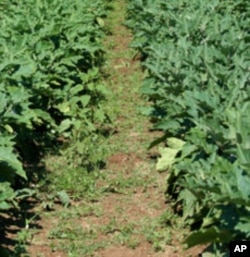
An Indian seed company called Mahyco has developed an eggplant that it says will dramatically reduce the amount of pesticides eggplant farmers will need to spray. Mahyco's genetically modified eggplant produces a protein called Bt, which kills the caterpillar. Bt is found naturally in a soil bacterium and has been used for decades as an organic insecticide.
Safety testing
Datta's institution was among those reviewing the B-t brinjal for health and environmental safety.
"It is absolutely safe," he says. "There is no unintended effect, there is nothing indigestible left, there is no toxicological effect. So the data with the Bt brinjal and non-Bt brinjal, there is no difference."
But every new genetically modified food has generated controversy, and the Bt brinjal is no exception.
"I think it's a disaster," says Pushpa Bhargava, one of the pioneers of biotechnology in India. He recommends a different set of tests that should be performed before any genetically modified crop is released. "Only about 10 to 15 percent of these tests have been done," he says. "And even these have been done by the company applying for permission for open release. And the company's credentials are as bad as could be."
New crops, old conflicts
The company at the heart of this debate is Mahyco's partner company, the U.S.-based agribusiness giant Monsanto. Monsanto has a long history of conflicts with green groups over its chemical business, which included such controversial products as Agent Orange and DDT. Conflicts have continued as Monsanto has become a leader in crop biotechnology.
Other Bt crops, including cotton and maize produced by Monsanto and other companies, have been reviewed, approved and grown widely in the United States, Canada, Australia and parts of Europe. To date, there have been no reports of serious environmental or health problems.
But Vandana Shiva, a prominent Indian opponent of crop biotech, is not convinced that something won't come up.
"I think for decades after DDT was sprayed you [heard] nothing. Many of these impacts take place much later," Shiva says.
Regulatory questions
Guillaume Gruere follows the biotech crop debate at the International Food Policy Research Institute in Washington, DC. He points to some flaws in India's regulatory system that may have added to people's concerns.
"Maybe...part of why it's all debated, and why people are not confident in this process," he says, is because, "there have been some mistakes on whether they should include people or not [and] what types of tests they were running," and other problems with the system.
Gruere says the tests that were done were sufficient, even if the process has been lacking.
Public outcry
India's genetic engineering approval committee endorsed the B-t brinjal. But with debate swirling around the issue, India's environment minister held a series of public meetings across the country in January, some of which became shouting matches between supporters and opponents.
"He really asked for criticism, and he got it," Gruere says.
Whether that criticism swayed him against Bt brinjal, or whether farmers eager to spray fewer pesticides will win out may be evident soon. On Feb.10, the environment minister is expected to issue his opinion.