



NEW DELHI —
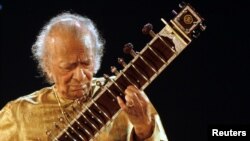
As India reflects on the legacy of sitar artist Ravi Shankar, who died on Tuesday in the United States, many are recalling what he meant for the country. The iconic musician, who carried Indian classical music to the West, has been called India’s greatest cultural ambassador.
Sounds from the multi-stringed instrument called the sitar helped Shankar captivate audiences across the globe. At the same time, the celebrated composer and musician raised India’s profile in Western countries. Lalit Mansingh, a former Indian ambassador to the United States, says he projected the country on the global stage in the 1960's and 70's when there were not too many people willing to bet on India.
“Remember, it was not very long after independence, India’s democracy was still an experiment, its economy was in shambles, and India in the west was routinely described as a black hole or a basket case," he recalls. "What Ravi Shankar did was to project the idea of India as a country that is rich in culture and which had a future. In that sense, the changeover in India’s image was largely due to people like Ravi Shankar and others like him, who contrasted India’s present poverty with its past richness and its future promises.”
Rise to fame
Ravi Shankar began playing in the West after receiving rigorous and traditional training in India. But he broke the mold as he experimented with fusions of Indian themes with Western classical and jazz styles. And as he played with top rock bands in the West, he helped close the musical gap between distinct cultures.
As he shot to fame in the West, he was showered with accolades at home. He was a member of the Upper House of Parliament from 1986 to 1992. He was given India’s top civilian award, the Bharat Ratna in 1999. Ravi Shankar composed the music for India’s favorite patriotic song and the signature tunes of India’s state owned broadcaster. He also composed some Bollywood film music.
But more than anything, his huge international success helped shake the dust off India’s 5,000-year-old heritage and classical art in the eyes of the world.
Star status
An Indian playback singer, Babul Supriyo, says he gave rock star status to Indian classical music.
“It is the charisma, the fame, the aura that he brought into classical music that is important for me," he says. "What Ravi Shankar did -- bring that glamour aspect which was kind of missing. That flamboyance, that élan that Ravi Shankar brought into classical music was one of the reasons why he got so well accepted.”
Lalit Mansingh, who knew Ravi Shankar for more than five decades, says he was born with an ability to communicate to people across the world. He says, the musician, also known as Panditji had an “amazing personality.”
“Very outgoing, very optimistic. He had this sense of enthusiasm, sense of curiosity…he would have views on everything, and it was always with a light touch," Mansingh says. "He would always enliven any meeting with his sense of humor and descriptions of his experiences and so on. The nice thing about Panditji is, he never started by saying what is in it for me, how much money are you giving me.”
In India, Ravi Shankar, will be remembered not just as one of the world’s greatest and tallest musicians, but also as its most famous musical son.
Sounds from the multi-stringed instrument called the sitar helped Shankar captivate audiences across the globe. At the same time, the celebrated composer and musician raised India’s profile in Western countries. Lalit Mansingh, a former Indian ambassador to the United States, says he projected the country on the global stage in the 1960's and 70's when there were not too many people willing to bet on India.
“Remember, it was not very long after independence, India’s democracy was still an experiment, its economy was in shambles, and India in the west was routinely described as a black hole or a basket case," he recalls. "What Ravi Shankar did was to project the idea of India as a country that is rich in culture and which had a future. In that sense, the changeover in India’s image was largely due to people like Ravi Shankar and others like him, who contrasted India’s present poverty with its past richness and its future promises.”
Rise to fame
Ravi Shankar began playing in the West after receiving rigorous and traditional training in India. But he broke the mold as he experimented with fusions of Indian themes with Western classical and jazz styles. And as he played with top rock bands in the West, he helped close the musical gap between distinct cultures.
As he shot to fame in the West, he was showered with accolades at home. He was a member of the Upper House of Parliament from 1986 to 1992. He was given India’s top civilian award, the Bharat Ratna in 1999. Ravi Shankar composed the music for India’s favorite patriotic song and the signature tunes of India’s state owned broadcaster. He also composed some Bollywood film music.
But more than anything, his huge international success helped shake the dust off India’s 5,000-year-old heritage and classical art in the eyes of the world.
Star status
An Indian playback singer, Babul Supriyo, says he gave rock star status to Indian classical music.
“It is the charisma, the fame, the aura that he brought into classical music that is important for me," he says. "What Ravi Shankar did -- bring that glamour aspect which was kind of missing. That flamboyance, that élan that Ravi Shankar brought into classical music was one of the reasons why he got so well accepted.”
Lalit Mansingh, who knew Ravi Shankar for more than five decades, says he was born with an ability to communicate to people across the world. He says, the musician, also known as Panditji had an “amazing personality.”
“Very outgoing, very optimistic. He had this sense of enthusiasm, sense of curiosity…he would have views on everything, and it was always with a light touch," Mansingh says. "He would always enliven any meeting with his sense of humor and descriptions of his experiences and so on. The nice thing about Panditji is, he never started by saying what is in it for me, how much money are you giving me.”
In India, Ravi Shankar, will be remembered not just as one of the world’s greatest and tallest musicians, but also as its most famous musical son.