



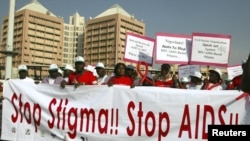
A new effort is underway to help migrant workers in developed countries who are disproportionately affected by HIV/AIDS. The International Organization for Migration announced a new program as part of World Aids Day activities on December 1.
The IOM said migrants, particularly those from poverty-stricken countries, are more vulnerable to contracting such communicable diseases as HIV/AIDS and TB. They are highly marginalized in society, lacking access to services, or they may be reluctant to use public services due to stigmatization.
Reiko Matsuyama, a migration health officer for IOM in Pretoria, South Africa, explains that, "mobility contributes to the phenomenon of concurrent sexual partnerships, which has been identified by most of the U.N. agencies, which contributes to the HIV epidemic. Also, in terms of access and also in health risks in general, involuntary and clandestine migration, such as people who are victims of trafficking or who are irregular migrants, who have high exposure to HIV through transactional sex, sexual violence, gender based violence, etc."
Matsuyama said that in the workplace, migrants are often left out of programs that are offered to permanent workers.
"A lot of the times these work places have fantastic HIV programs, but only target permanent workers, and not contract workers, seasonal workers, temporary workers, who are mostly migrants. So it is also the marginalization of access to health services and workplace programs because of that migration status," said Matsuyama.
The IOM points out that, contrary to popular belief, migrants arrive in countries in relatively good health. It is often the work environments and poor living conditions that contribute to their exposure to diseases such as HIV. Matsuyama explained that South Africa is a good example of where this is occurring, because it has such a high percentage of migrants.
“This is in the mining industry, construction, agriculture, the farming communities etc. What we have found is that actually migrants are self-selective. They are job seekers. They are looking for work," said Matsuyama. "So they wouldn’t travel unless they’re healthy to begin with, said Matsuyama who went to explain, “but then when they do travel and the factors that are in place while they are traveling, I mentioned a lot of the sexual violence that may occur - I’ve had anecdotal evidence of informal, cross-border traders being subject to gender-based violence, as well as the conditions that surround the working, living conditions.”
Matsuyama cited results from a survey recently performed by the IOM in several farming communities of South Africa that included over 2,000 participating workers, of which half were women; the survey revealed that a very high percentage of sexual violence had taken place in the work environment.
“We found overall extremely high prevalence of 39.5%. In some areas where they are very close to the border of Mozambique and Swaziland, we found over 49% prevalence. So it’s the conditions that are surrounding the workplace. There’s high risky sexual behavior, gender-based violence, alcohol abuse, and also food insecurity that makes people vulnerable in these communities,” she said.
The IOM also works very closely with various local and regional organizations to help bring awareness of the health needs of migrants.
“Specifically in terms of the diaspora, we have specific projects and programs where we try to utilize diaspora engagement for development. . . whether it’s in the field of health or education or other technical fields,” said Matsuyama. She also pointed out that diaspora engagement, in terms of health and education development, is vital to the overall efforts in addressing communicable disease such as HIV and TB among migrants.
The IOM said migrants, particularly those from poverty-stricken countries, are more vulnerable to contracting such communicable diseases as HIV/AIDS and TB. They are highly marginalized in society, lacking access to services, or they may be reluctant to use public services due to stigmatization.
Reiko Matsuyama, a migration health officer for IOM in Pretoria, South Africa, explains that, "mobility contributes to the phenomenon of concurrent sexual partnerships, which has been identified by most of the U.N. agencies, which contributes to the HIV epidemic. Also, in terms of access and also in health risks in general, involuntary and clandestine migration, such as people who are victims of trafficking or who are irregular migrants, who have high exposure to HIV through transactional sex, sexual violence, gender based violence, etc."
Matsuyama said that in the workplace, migrants are often left out of programs that are offered to permanent workers.
"A lot of the times these work places have fantastic HIV programs, but only target permanent workers, and not contract workers, seasonal workers, temporary workers, who are mostly migrants. So it is also the marginalization of access to health services and workplace programs because of that migration status," said Matsuyama.
The IOM points out that, contrary to popular belief, migrants arrive in countries in relatively good health. It is often the work environments and poor living conditions that contribute to their exposure to diseases such as HIV. Matsuyama explained that South Africa is a good example of where this is occurring, because it has such a high percentage of migrants.
“This is in the mining industry, construction, agriculture, the farming communities etc. What we have found is that actually migrants are self-selective. They are job seekers. They are looking for work," said Matsuyama. "So they wouldn’t travel unless they’re healthy to begin with, said Matsuyama who went to explain, “but then when they do travel and the factors that are in place while they are traveling, I mentioned a lot of the sexual violence that may occur - I’ve had anecdotal evidence of informal, cross-border traders being subject to gender-based violence, as well as the conditions that surround the working, living conditions.”
Matsuyama cited results from a survey recently performed by the IOM in several farming communities of South Africa that included over 2,000 participating workers, of which half were women; the survey revealed that a very high percentage of sexual violence had taken place in the work environment.
“We found overall extremely high prevalence of 39.5%. In some areas where they are very close to the border of Mozambique and Swaziland, we found over 49% prevalence. So it’s the conditions that are surrounding the workplace. There’s high risky sexual behavior, gender-based violence, alcohol abuse, and also food insecurity that makes people vulnerable in these communities,” she said.
The IOM also works very closely with various local and regional organizations to help bring awareness of the health needs of migrants.
“Specifically in terms of the diaspora, we have specific projects and programs where we try to utilize diaspora engagement for development. . . whether it’s in the field of health or education or other technical fields,” said Matsuyama. She also pointed out that diaspora engagement, in terms of health and education development, is vital to the overall efforts in addressing communicable disease such as HIV and TB among migrants.