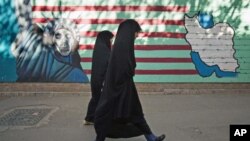
Iranian officials have strongly denounced U.S. allegations of a Tehran-linked plot to kill a Saudi diplomat in the United States. Some in Iran are arguing that the case has been fabricated to provoke a military confrontation with the Islamic Republic.
The reaction from Tehran has been swift and categorical. A foreign ministry statement drove home the denials, condemning the U.S. claims as baseless and warning against the repetition of what it called "politically motivated allegations."
Saeed Laylaz, a political analyst in Tehran, said the case will take already fraught relations between the U.S. and Iran to a whole new level.
Laylaz said even ahead of this accusation, he saw the possibility of a military confrontation between the two countries. He said he imagines the latest incident is potentially laying the groundwork for a U.S. propaganda campaign against Iran.
That sentiment was echoed on the streets of Tehran.
City resident Sadeghian, who did not give his first name, argued that U.S. sanctions against Iran failed, so Washington is looking for other ways to create a bad image of his country to present to the world.
Other residents in the Iranian capital placed the blame elsewhere.
Javad Foroozan called the incident "a plot by the Zionists and Saudi Arabia."
Saudi Arabia said Wednesday that Iran must "pay the price" for the alleged plot to kill the Saudi ambassador in Washington. It wants to take the matter before the United Nations.
Saudi Arabia has long had a rivalry with its non-Arab, mainly Shi'ite neighbor. The Sunni-led kingdom has accused Iran of plotting against it in the past, and according to leaked U.S. diplomatic cables, King Abdullah has wanted the U.S. to "cut off the head of the snake" - a reference to Iran.
Tensions between Iran and the Saudis have only increased with the popular uprisings across the region this year, in particular when Saudi forces backed the suppression of a largely Shi'ite revolt in Bahrain.
As for "Zionists" - a term often used in Iran to mean archenemy Israel - accusations by Tehran against Israel are so common that it's hard to gauge the seriousness of this current charge.
But Iran is not alone in raising questions about the U.S. claims.
Associate Editor Max Fisher of The Atlantic spoke to VOA via Skype, saying, “It's certainly plausible that Iran might want to assassinate a Saudi official, but this kind of operation is pretty serious in size and scope, and the ramifications it would have for Iran's policy. And it's just not clear what they would get out of it. It's not clear why they would want to blow up the Saudi ambassador to the U.S. And, in fact, there are reasons to believe it would go against Iran's interests.”
Top among those reasons, he argued, is that U.S.-Saudi relations, currently frayed over such issues as Bahrain, would be strengthened in a show of solidarity, something that could only hurt Iran.
Iran Rejects US Claims of Saudi Plot