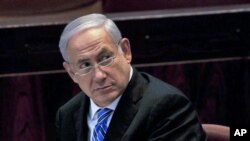



Israel says it will ask President Obama to clarify remarks in his speech Thursday in which he said the future borders of Israel and Palestine should be based on the 1967 lines.
President Obama's remarks, during a major address on the Middle East, drew an immediate response from Israeli Prime Minister Benjamin Netanyahu, who issued a statement as he prepared to leave for Washington, where he is to meet Friday with the U.S. leader.
Mr. Obama appeared to upset Israeli leaders by saying the borders of Israel and a future Palestinian state should be based on the 1967 lines with mutually agreed land swaps.
The "1967 lines" reference is to pre-war boundaries before Israel captured the West Bank, East Jerusalem, Gaza Strip and Golan Heights in fighting with Jordan, Egypt and Syria.
Israeli foreign ministry spokesman Yigal Palmor says Mr. Netanyahu will ask President Obama for clarification of the remarks.
"The 1967 line was never an international border. It was never recognized as such. It was a cease-fire line with many unclear areas that were considered no-man's land and therefore because of their nature, they are considered an indefensible border," he said.
Palestinian analysts praised Mr. Obama's call for Israel to negotiate a permanent border based on the lines that existed before the 1967 Arab-Israeli war.
Hanna Siniora is a member of the Palestine National Council from East Jerusalem. He said that while he believes Mr. Obama made significant concessions to the Israelis by - among other things - reaffirming a U.S. commitment to Israel's security, emphasizing borders was an important point for the Palestinians.
"We heard all American administrations talk about unshakeable security for Israel. We are not against security for Israel, but we are asking at the same time for security for the Palestinians, and this can only happen if the border between the two states is defined," he said.
Palestinian negotiators have expressed frustration over what they say has been Israel's reluctance to discuss borders.
In his speech, Mr. Obama barely touched on other key issues including the status of Jerusalem and refugees.
Oded Eran, director of the Institute for National Security Studies in Tel Aviv, says President Obama is pressing Mr. Netanyahu to address the borders issue now.
"He told him that he will not press him on the other issues. But he told him 'Mr. Netanyahu, you have to move on the territorial issue and you have to answer me on this issue,' Eran said.
Israeli officials say Mr. Netanyahu hopes to hear a reaffirmation from President Obama that the United States will adhere to a previous U.S. commitment on the borders issue.
In a 2004 letter, then-President George W. Bush told Israeli leaders it was, in his words, "unrealistic" to expect a return to original armistice lines, given what he said were the new realities on the ground - realities that he said included the existence of Israeli population centers in the West Bank. That is a reference to settlements Israel has built since capturing the territory.
Israel Objects to Obama Remarks on Borders