


News / Africa

Ivory Coast Gas Runs Low, Newspapers Close

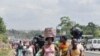
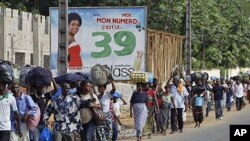
Residents of the Abobo district carry their belongings as they flee the neighborhood which has become a hub for street violence in the nation's ongoing political standoff, in Abidjan, Ivory Coast, February 28, 2011
TEXT SIZE - +

People in Ivory Coast are feeling the effects of the country's political crisis, with signs of a gasoline shortage and the closure of eight daily newspapers.

The owners of the independent newspapers released a joint statement Tuesday citing ongoing "judicial and police harassment" by supporters of incumbent president Laurent Gbagbo.  The dailies claim they are being targeted for refusing to back Mr. Gbagbo.

The incumbent president is defying international pressure to step down and cede power to Alassane Ouattara, whom most countries recognize as the winner of a November presidential election.

In a statement Tuesday, the media rights group Reporters Without Borders said privately-owned newspapers are being "hounded and threatened."  The group also said a media war has broken out between pro-Gbagbo and pro-Ouattara supporters - creating what it called an "impossible situation for the press."

The group reported that attackers wielding clubs and machetes killed an employee for a pro-Gbagbo daily newspaper in southern Abidjan on Monday.

In another development, Mr. Gbagbo's government has banned residents from filling jerricans with gasoline.  Mr. Gbagbo's mines minister announced the ban on Monday, prompting a rush to stockpile fuel.

The European Union has frozen the assets of Ivory Coast's port and its state oil firm to pressure Mr. Gbagbo to transfer power.

Meanwhile, fighting in the main city of Abidjan appeared to have subsided on Tuesday, after six straight days of violence between pro-Gbagbo forces and supporters of Mr. Ouattara.

Most of the clashes have taken place in the pro-Ouattara neighborhoods of Abobo and Anyama.  On Monday, Mr. Gbagbo ordered a three-day overnight curfew in those districts.

Some information for this report was provided by AP and AFP.
You May Like

India, China Pledge to Overcome Border Tensions

Indian prime minister and Chinese premier attempt to move past tense standoff in the Himalayas during Delhi talks More

Burmese President Opens US Visit with VOA Town Hall Meeting

Ahead of his meeting with President Obama Monday, Thein Sein answered questions on human rights and economic development in his country More

Video Washington Week: Focus on Burma, US Government Scandals

President Thein Sein visits the White House on Monday, Congressional probes of multiple scandals are continuing More

This forum has been closed.
Comments
     
There are no comments in this forum. Be first and add one

Featured Videos

Your JavaScript is turned off or you have an old version of Adobe's Flash Player. Get the latest Flash player.
Video

Video Boston Bomber Spent 6 Months in Russia’s Most Violent Republic

The news of the Boston Marathon bombings circled the globe, and resonated here in Dagestan, a majority Muslim republic in Russia, on the shores of the Caspian Sea. Last year, Tamerlan Tsarnaev, the older of two brothers suspected of the bombings and a long-time Boston resident, returned to Dagestan, where he had lived for a year during his youth. Dagestan was the land of his maternal ancestors. But in the last two years, this republic of 3 million people has gained notoriety as the region with the highest level of political and religious violence in all of Russia. VOA's James Brooke reports from Makhachkala, Russia.