


News / Asia

Japan's Economic Fallout Worse than First Thought

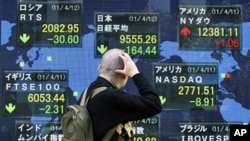
A man looks at the closing price of Japan's Nikkei share average (top C) displayed along with major indexes outside a brokerage in Tokyo, April 12, 2011
TEXT SIZE - +

Japan's economic minister says the damage to the country's economy from last month's earthquake and tsunami is worse than first thought.

Japan had estimated that the damage may total as much as $295 billion, a figure that did not include the cost of possible contamination of food and water from radiation leaks from the crippled nuclear reactors at Fukushima.

But on Tuesday, economic minister Kaoru Yosano said the blow to the Japanese economy is "larger than our original expectations." He did not make a new estimate but said the damage is "wide-ranging," hitting the northeast sector of the country with its sophisticated manufacturing industries.

Japan's infrastructure has been devastated and its manufacturing supply chains broken. Production at some of the country's largest manufacturers -- Toyota, Honda and Sony -- has been stymied. The International Monetary Fund has lowered its 2011 economic growth forecast for Japan, the world's third biggest economy, from 1.6 percent to 1.4 percent. But one economic research company (Capital Economics) says Japan's economy may shrink by 1.5 percent this year.

A month after the twin natural disasters, Japan has not decided how to refinance the recovery. Its public debt is already the industrialized world's biggest at about 200 percent the size of its economy.

Prime Minister Naoto Kan, whose political fortunes had plummeted even before the earthquake and tsunami, may be forced to sell more debt or raise taxes. Tax increases could further diminish Japanese consumers' confidence and willingness to spend as the scope of the nuclear disaster remains unclear. One survey that tracks confidence among merchants closest to the country's consumers showed it tumbled at the fastest pace ever in March.  

Some information for this report was provided by AFP and Reuters.

You May Like

Pakistan Reiterates Opposition to US Drone Strikes

Day earlier US President Barack Obama justified 'constrained' drone usage to save lives More

Study Identifies Risks of Human Spread of H7N9 Bird Flu

Study suggest that international measures to contain the H7N9 influenza, in the event of severe outbreak, will need to be targeted in Asia More

Violence Continues in Conakry Over Upcoming Elections

Opposition has called for boycott of elections More

Video Syria's Civil War Fuels Violence in Iraq

Analysts say al-Qaida-linked militants are flowing back and forth from both countries More

Video Star Trek Influence Lives Long and Prospers

As new movie thrills, many are once again discussing the iconic franchise's influence on society, science and technology More

OECD: Developing Green Cities Key to Sustainable Future

OECD suggests strategies to mitigate rapid growth, industrialization in urban centers, which produce about two-thirds of greenhouse gas emissions More

This forum has been closed.
Comments
     
There are no comments in this forum. Be first and add one

Featured Videos

Your JavaScript is turned off or you have an old version of Adobe's Flash Player. Get the latest Flash player.
Video

Video Volunteers Help Revive LA's Concrete River

The Los Angeles River is a concrete drainage channel through much of its 80-kilometer length. It channels waste-water from storm drains and has become a receptacle for much of the city's trash. But as Mike O'Sullivan reports, the river is slowly being restored with the help of volunteers, who take part in an annual clean-up.