



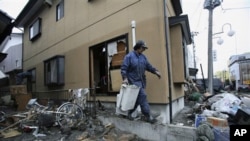
An international disaster assessment group says Japan’s preparedness for earthquakes and tsunamis saved lives, even though more than 3,000 people have been confirmed dead and thousands more are missing.
Japan has a long reputation of being the most well prepared nation to face earthquakes and tsunamis. Tough building codes, sea walls and local emergency warning systems all are in place.
But last Friday, faced with an earthquake of magnitude 9.0 - the strongest in Japan’s seismic history - preparations fell short to save all lives.
Asian Disaster Preparedness Center Program Manager Aslam Perwaiz says Japan was simply overwhelmed by natural forces. But the tsunami early warning systems in local communities saved many lives, says Perwaiz.
"The preparedness worked in Japan in this case. The only thing that did not work is understanding this much of intensity [of the disaster]. Otherwise, for example, they were well prepared for an earthquake and related tsunami of a magnitude 8.0/8.3 but between 8.3 and 9.0 that is a huge difference," he says.
Now Japan’s tragedy is complicated by fires and explosions at the Fukushima nuclear power station.
Concern about radioactive fall-out from the nuclear power stations that led to thousands being evacuated has added to the scale of the disaster, says Perwaiz.
"There will be a big health hazard. At one point of time, we have this problem of the immediate result of the tsunami. Then we have the problem of nuclear, compounding a big health hazard, if the response time is not completed within the month, which is an uphill task."
The United Nations Office for Coordination of Humanitarian Affairs says nearly 416,300 people have been evacuated from the earthquake and tsunami affected provinces, with more than half from Miyagi Province.
The regional spokesperson for the U.N. agency, Kirsten Mildren, says people in the hard-hit areas face limited access to water and shelter, including evacuation centers.

"It is also winter in Japan right now, and so, without electricity, without proper heating, now the government has announced there is going to be power cuts," she says. " This is going to put an extreme amount of pressure on the people themselves, because it is literally freezing overnight."
Clean up and recovery will take a long time, says Mildren.
"Infrastructure has been devastated in this particular area, and this was luckily a rural area, but it certainly had a lot of manufacturing. So for Japan, the cleanup operation is going to be monumental," she says.
Japanese Prime Minister Naoto Kan has ordered a shift toward humanitarian operations from immediate rescue activities to provide essential items to the affected areas.