


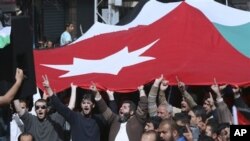
Amid heavy security, thousands of protesters including the Muslim Brotherhood, youth groups and smaller political parties marched in Amman demanding government reforms and parliamentary elections.
As uprisings continue to threaten governments across the Middle East, Jordanian protesters took to the streets for the eighth week in a row on Friday, in what many believe to be their largest protest to date.
"The people demand an elected government," they shouted, before denouncing the recently fired prime minister, along with current Prime Minister Marouf Bakhit, both named by King Abdullah II. After Friday prayers, protesters, loosely divided into groups including Jordan’s largest opposition party, the Muslim Brotherhood, marched through downtown surrounded by thousands of police officers in what has become a weekly event.
But unlike violent clashes that have plagued many of the protests in the Arab World, and injured eight in Jordan last week, this Friday’s demonstrations were notably polite.
Police handed out juice boxes and bottled water, and protesters dispersed swiftly when the demonstration officially ended in the early afternoon. A cleaning crew in orange suits swept the streets, finding little trash had been left behind.
Despite the relative serenity of the Jordanian protests, activists say they are no less determined that their demands will be met. Activist Omar Abu Rasah said he is prepared to sleep on the streets until he has some kind of guarantee that Jordanians will be legally guaranteed elections and future liberties.
"We want an elected government," said Abu Rasah. "We want to give all the authorities for the people. Directly, something like a Magna Carta, as what happened in England. We are looking for these kind of changes now in Jordan."
Like most protesters, Abu Rasah said he supports the Jordanian monarchy, but wants to empower voters with legal reform, like the famed 13th Century Magna Carta that limits the power of the English monarchy and guarantees the rights of the people.
"We want to keep the kingdom, we want to keep the king, but we want the authority for the people," added Abu Rasah.
Protesters say they want swift investigations into corruption charges and economic reforms. Jordani journalist Tariq al Hmedy said he has been covering the protests since they began two months ago, and they continue to grow. Al Hmedy said demonstrations have consistently drawn average working-class people, who live on $350 a month, or less, in what many say is the Middle East’s most expensive city.
But unlike past protests, al Hmedy said today’s demonstrations drew more of what are traditionally pro-government groups from outside the capital, Amman. These groups, he said, are now opposing the government and demanding their rights.
"It’s the first time people come from outside Amman, from the Bedouin, from outside Amman, from the other cities, and say ‘No, stop. We want to do something. We won’t allow for you to steal our money and steal our freedom,'" noted al Hmedy.
Protesters also say they want to stop soaring food prices, high taxes and nepotism. Since the protests began, King Abdullah has replaced his cabinet, appointed a new prime minister and promised wide-spread reforms. And even though activists hold pictures of the monarch and chant, "Abdullah we love you!" they still say the changes are not coming fast enough.