




As Americans increasingly turn to the Internet for their news — and advertisers follow them — newspapers and magazines are struggling to stay in business. In San Francisco, an unlikely group of partners may have found a way to keep old-fashioned journalism alive in the digital age.
The visionaries behind the just-launched Bay Citizen say it is not your typical news website. Editor-in-Chief Jonathan Weber proclaims that a long-expected revolution is now fully under way.
A mix of old and new
The native-to-the-web news site, Bay Citizen relies on reporters with traditional investigative skills and reliable sources to produce written stories on screen, as well as audio and video reports. And it features trendy ways to leave comments that are now familiar to Internet users. But the Bay Citizen's editors have also added data-related graphics and interactive applications.
Weber sees ways to tell stories online that go beyond what can be done in print.
"We can take publicly available data of many kinds — which could range from crime data, to real estate data, to real-time maps of where the taxis are going," he explains. "If we can organize that and provide access and an interface to that with tools that are easy to use and potentially fun to use, so you can enable people to run their own applications on that data — people can come in and pick out what's interesting to them."
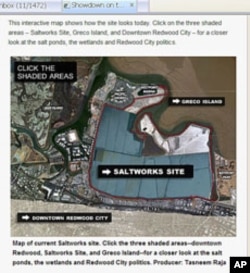
Bay Area resident and new reader Rebecca Otto became captivated by an interactive map illustrating a story about a region of salt flats.
"You could look at a specific area within that salt water region and really, really get to know a lot of detail that you wouldn't normally see in a newspaper story." She says she found herself staying with articles longer and coming out of them with a deeper understanding than she got from a traditional newspaper story.
New way to look at news
The Bay Citizen is getting help from some cutting-edge thinking at the University of California at Berkeley.
Neil Henry, dean of its Graduate School of Journalism, has completely redesigned the curriculum to meet the challenge of the digital age. And he's harnessed the Knight Digital Media Center to train students — and re-train working journalists — in multimedia storytelling and digital skills.
Henry feels a sense of urgency. "More than half of the journalists in the Bay Area, — at newspapers, radio and television stations — have lost their jobs over the past decade," he says. "We see the newspapers shrinking and disappearing before our eyes. Our students are out covering news and information for the local sites we've built and often they are the only reporters in these areas. So we feel this crisis very deeply. Something important to our society was being lost."

San Francisco financier and civic philanthropist Warren Hellman also sees the decline of the newspaper industry as bad news. "Like a lot of other people," he says, "I became really concerned about the lack of coverage of local news. It seemed to me that bad things were happening politically or in the community because stuff just wasn't getting covered."
Hellman decided to start a non-profit newspaper to meet that need, but after talking with Dean Henry and other local civic leaders and media professionals, he brought in $5 million from his family foundation as seed money for the Bay Citizen.
A news hub
"What we've actually ended up with is far more exciting," Hellman says, describing the venture as a news hub and a news partner to all kinds of other outlets.
For example, The Bay Citizen has already partnered with the New York Times. It is producing two pages of San Francisco Bay Area news for the local edition of the Times twice a week.
And the editors are hoping to syndicate Bay Citizen stories to other national publications, as well as radio, television and online outlets. They'll also get the news out through mobile applications and social media.
Australian native Lisa Frazier, a former management consultant, now heads the company. She revels in its first exciting week with sponsors pledging an additional $3.7 million, a launch party attended by 800 people, and stories that have been very well received.
Nevertheless, she recognizes The Bay Citizen's ambitious challenges. "We're trying to start to solve a three-part problem which is journalism, technology, and business."
The Bay Citizen will use some Berkeley journalism students, along with their professional news reporters, to gather the news — an interaction, Frazier says — that will foster technological innovation.
"There's nothing, I think, better than a 25-year news veteran being brought to a table by a 25-year-old student journalist who's saying, 'Let's get the news out through Twitter and Facebook.'"
Frazier plans to meet the bottom line business challenge with a mix of revenue streams: grants and sponsorships; reader memberships — not subscriptions — corporate advertising and syndication rights.
Above all, editor Jonathan Weber promises, the Bay Citizen will keep its readers informed, noting that that's the mission at the heart of journalism.
"One of the other things that online enables that's very significant, is real engagement and participation in the news process, and a much more intimate relationship between the reporters and the readers. And sometimes readers can be reporters. And so we view a big part of our mission is to foster engagement in the issues of the day."
That, he says, helps put the citizen in the Bay Citizen.