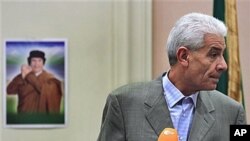
Western officials have hailed the defection of Libya’s foreign minister as a sign that Moammar Gadhafi’s government is falling apart. However, Colonel Gadhafi’s forces have mustered a blistering counter-offensive that has pushed back opposition rebel forces. The minister’s defection, though, is a potential gold mine of intelligence about the Libyan government.
Prior to his job as Libya’s top diplomat, Moussa Koussa was the chief of Libyan intelligence, making him one of the most senior figures around Gadhafi. Reva Bhalla, Middle East analyst with the private intelligence firm Stratfor, said that makes Koussa’s defection an intelligence bonanza for the West.
"This is somebody that every Western intelligence agency has a big file on. He knows where the bodies are buried, so to speak. And so he would have an enormous amount of information that would be useful to the coalition partners in basically just figuring out Gadhafi’s vulnerabilities," said Bhalla.
Former senior CIA intelligence officer Emile Nakhleh said Koussa was at the center of just about every policy decision made by Gadhafi, and is intimately familiar with the workings of the Gadhafi government.
"I think it is extremely important because he has perhaps over the years been one of the closest people to Gadhafi - and not just the closeness, the proximity to power, but the involvement," said Nakhleh. "He has been involved in so many decisions, major, major decisions regarding Libya, both nice and nefarious, if you will."
Koussa led the negotiations with the West to have Libya abandon its nuclear weapons programs in return for the lifting of international sanctions. But analysts say that as Libyan security chief, he also was involved in Libyan support for terrorism.
Analysts believe efforts to get Koussa to abandon Gadhafi have been ongoing for some time. Nakhleh said that, given Koussa’s position and knowledge, he would be a prime target.
"I don’t believe that he necessarily decided on his own. I judge that intensive behind-the-scenes contacts must have been occurring between him and Western - people from the West, let’s say. I would be appalled, frankly, if our intelligence services and our government had not attempted to contact him and encourage him to leave," said Nakhleh.
Koussa surfaced in Britain, which, analysts say, make it likely the defection was engineered by the British intelligence service, MI-6. He also was Libya’s ambassador to Britain in 1980.
In announcing Koussa’s arrival, British Foreign Secretary William Hague pointed to the defection as a sign that Gadhafi is fast losing support. "His resignation shows that Gadhafi’s regime, which has already seen significant defections to the opposition, is fragmented, under pressure, and crumbling from within. Gadhafi must be asking himself, who will be the next to abandon him."
Other Libyan officials are reported to have defected. Bhalla points out, however, that some of those defection reports have proved false, and warned against reading too much about Gadhafi’s staying power into them.
"I think the defections overall are being exaggerated to some extent. There was a lot of rhetoric that followed from the European capitals and from Washington saying that, well, this was the clearest sign that Gadhafi is completely isolated and that his days are numbered. And, of course, Gadhafi is in a difficult position. But I don’t think that his situation is as dire as some are portraying him to be in."
Nakhleh said the real defections to watch for would be of any of Gadhafi’s sons. That, he said, would be the clearest indicator that the Libyan leader really is on his last legs [ready to collapse].
Libyan Defection Is Potential Intelligence Goldmine
- By Gary Thomas