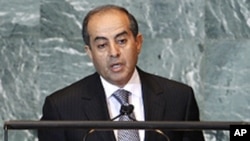
The head of Libya’s National Transitional Council appealed directly to the U.N. Security Council Monday, asking it to lift the remaining sanctions on Libya so the country could rebuild. Mahmoud Jibril also warned that the stability of Libya will be at risk as long as former Libyan leader Moammar Gadhafi is on the loose.
Interim Prime Minister Mahmoud Jibril told the 15-member Security Council that the continuing sanctions are a factor feeding instability in Libya.
“We must not only fight against a despotic regime, but the Libyan people are counting on the capacity of the NTC to be able to provide the basic needs of the citizens," he said. "The inability of the NTC or provisional government to provide these kinds of services because of a lack of funding, could affect the very foundations of this council that you have recognized.”
The Security Council has already moved to unfreeze $16 billion in Libyan assets, but the NTC hopes to get access to billions more that is still restricted.
Jibril also warned that Moammar Gadhafi has a lot of assets at his disposal, which make him a formidable adversary. He said his wealth and connections enable him to threaten stability not just in Libya, but across the African continent.
“This is no exaggeration to say that even beyond the African continent, Gadhafi with the means that he has, could return to his terrorist practices by providing arms across the continent to prove that it was true when he said that his absence from the political stage would be synonymous with the expansion of al-Qaida and terrorist organizations,” said Jibril.
U.N. political chief Lynn Pascoe briefed the council. He said one of the main challenges facing the NTC is for it to establish control over the large stocks of sophisticated arms, including ground-to-air missiles and chemical weapons, that the Gadhafi government possessed.
“The spread of these weapons and the danger they could fall into the hands of terrorists are matters of grave concern," said Pascoe. "Re-establishing control over chemical weapons material is of paramount importance.”
Mahmoud Jibril shared the U.N.’s concern on that issue and said the collection of arms is one of the NTC’s main priorities.
The U.N.’s Pascoe also said reports of a mass grave near the Abu Salim prison with some 1,270 remains - reportedly of prisoners killed during a massacre in 1996 - must be investigated and any evidence preserved for future trials.
The United Nations is in the process of deploying between 100 and 200 personnel to Libya as part of a support mission to assist the National Transitional Council with the shift to democracy.
Libyan NTC Chief Warns Gadhafi Must Be Caught