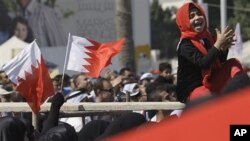
Security forces in Libya and Yemen have carried out more deadly shootings against anti-government protesters, while thousands of pro-democracy activists in Bahrain have returned to a major square following the withdrawal of security forces.
Witnesses and media reports in Libya say security forces shot and killed at least 15 protesters in the second largest city of Benghazi Saturday, as crowds gathered for the funerals of other activists. Some residents say snipers opened fire after the mourners tried to storm a military building. They described the shootings as a massacre.
Libyan authorities also cut off Internet services in the country Saturday, denying cyber activists a key tool to mobilize demonstrators. The anti-government protests that erupted last week represent an unprecedented challenge to the four-decade rule of Libyan leader Moammar Gadhafi.
In Yemen, officials say police opened fire at opposition activists staging a daily march from Sana'a University toward the city center, killing at least one protester. Supporters of Yemeni President Ali Abdullah Saleh armed with clubs and knives also attacked the protesters, who responded by throwing stones. Similar confrontations have erupted in Sana'a for 10 days.
In Bahrain, thousands of jubilant opposition protesters moved back into Pearl Square in the capital, Manama, Saturday, setting up a tent camp after the Gulf state's minority Sunni rulers ordered police and army forces to withdraw.
Bahrain's ruling al-Khalifa family also offered to open a dialogue with the majority Shi'ite-led opposition, which has demanded democratic reforms to strip the constitutional monarchy of its powers to fill key government posts.
Elsewhere, Algerian police blocked hundreds of anti-government demonstrators from marching in the capital, Algiers, Saturday. Protesters who tried to reach a central square chanted slogans for a "free and democratic" Algeria, but police turned many of them back.
In Djibouti, authorities detained three top opposition leaders. Djibouti's chief prosecutor, Djama Souleiman, says the three were detained in connection with violent clashes Friday between opposition protesters and security forces.
Anti-Government Protests Continue in Bahrain, Libya, Yemen
- By Diaa Bekheet