



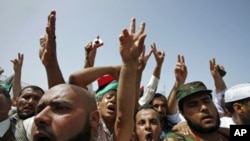
A week after declaring it had moved to Tripoli, Libya's National Transitional Council has yet to establish a firm footing in the capital. It looks like it will be a long road ahead for the provisional authorities.
The burst of enthusiasm after Tripoli fell to the rebels helps to explain the overly optimistic announcement that provisional authorities had set up shop in the capital. But the reality is proving more daunting.
In the short term, NTC forces must rout the last of Moammar Gadhafi's troops. Officials who are in Tripoli struggle to provide regular running water and electricity. And they need to disarm militias.
Tripoli representative Al Amin Belhaj said the NTC's six months in opposition have been a guide.
"We have learned and learned experience from the eastern side, in Benghazi, where the police and the security people left their jobs, and we had a problem to bring them back. No, no, no, in Tripoli we will not do that. They are a major part of rebuilding the security in Tripoli," said Belhaj.
Not everyone in Tripoli is confident that bringing Gadhafi loyalists into the fold will be easy.
Yusef Mohammed, a civil engineer in the city, said, "This will take some time, before they return their mentality because no education, nothing. I mean, even in the TV [there were] five or six channels all that he's talking about is killing and how to treat people badly."
The NTC has said from the beginning it wants a united Libya, and despite some internal divisions, has received at least initial support from other factions.
Saleh Wali ran an opposition cell in the capital independent of the NTC. He said he is happy to follow NTC orders.
"We are all agree that Mustafa Abdel Jalil, he's our new president and really we like him. Nice person, good person. He and Mr. Mohamed Jabril. Really, really, I feel that, all the people, they love them," said Wali.
Equally important, the NTC leaders have friends abroad. Billions of dollars have been pledged in aid and unfrozen Libyan assets. But outside help could come at a cost, as Gadhafi loyalists accuse the NTC of selling out to foreigners interested only in Libya's oil wealth.
Optimism remains, though. Salem el-Maiar, a member of Britain's Society for Libyan Studies, is hopeful the NTC is on the right track.
"It’s been quite a burdensome and quite a heavy inheritance that we had. Forty-two years is an extremely long time and it can not be changed overnight. Obviously, we need at least a good decade to get things back to normal in terms of politics, economical, social and all aspects of life in Libya," said el-Maiar.
But with the current problems of the transitional government, time may not be an ally.