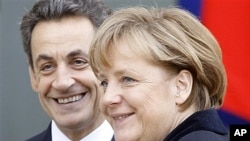
The French and German leaders want to amend key European treaties to provide greater fiscal oversight and governance over the ailing, 17-member euro currency union. Following talks in Paris Monday, they outlined a series of measures to resolve the eurozone crisis that they plan to present at a European Union summit this week.
Europe's two biggest economies appear to have resolved major differences on how to save the euro currency union.
Speaking at a joint news conference with his German counterpart, Angela Merkel, French President Nicolas Sarkozy outlined a series of steps the two leaders have agreed on. Key among them are mandatory limits on budget deficits that eurozone members must adhere to, or risk possible sanctions. Both want eurozone nations to meet monthly to deal with the crisis. And they want the new rules to be part of a renegotated European Union treaty to be completed by March.
Sarkozy said Europe's sovereign debt and banking crisis makes it all the more critical for France and Germany to offer a united front. To disagree, he said, is to risk having Europe and the euro currency explode.
Angela Merkel said Europe faces a very difficult situation. It is critical to reestablish confidence on the part of investors and the international community.
The two leaders will seek endorsement from European Union leaders at a summit later this week. Mr. Sarkozy said they hope all 27 EU leaders will agree to their proposals, but if not, they will push for agreement from the 17 eurozone members.
Markets already are rising in expectation that European leaders will make key decisions this week. But Thomas Klau, head of the Paris office for the European Council on Foreign Relations, doubts the EU summit will resolve the euro crisis once and for all.
"Will the summit in Brussels…be the one to end this prolonged crisis? I'm skeptical," said Klau.
Monday's meeting in Paris is one of a series of high-level talks on the crisis this week. Underscoring growing fears of the crisis spreading overseas, U.S. Treasury Secretary Timothy Geithner is in Europe this week meeting with top officials, including Sarkozy and Italy's new Prime Minister Mario Monti.
Sarkozy, Merkel Agree on Steps to Save Euro Currency Union
- By Lisa Bryant