



At Cairo's posh Gazeera Club, workers leave the showers running as they sit nearby drinking tea and chatting. Large quantities of water pour down the drain as water pipes around the city and its suburbs run dry.
For inhabitants of Cairo’s poor neighborhoods, water only infrequently arrives via government pipes. In order to cook and stay hydrated, says resident Hossam Abdel Razaq, housewives trek to a local water dealer and buy the precious liquid for 25 cents. When water does briefly flow, he adds, kids run to the faucets to drink.
A regional problem
Due to increasing populations, climate change, poor infrastructure and inefficient use of resources, serious water shortages are threatening the lives and livelihoods of millions of people across the Middle East.
In Egypt, government statistics indicate the country uses 55 billion cubic meters of water per year, 87 percent of which comes from the River Nile. But conflict with neighboring states upriver, however, is creating tension and could exacerbate the crisis.
Governments in Ethiopia, Kenya, Uganda and Southern Sudan argue that they should get a larger share of the Nile's waters, but Egypt and Sudan insist that a British colonial agreement gives them the right to use most of the Nile's waters.
Omar Ashour, who teaches political science at the University of Exeter in Britain, says Egypt is paying a price for years of benign neglect of southern neighbors.
"What we're harvesting now is decades of bad foreign policy when it comes to the central African and southern neighbors," he says. "During Mubarak's time there was the complete ignoring of development projects, of cooperation, and there was this superiority-inferiority complex reflected in foreign policy towards neighbors in the south, especially Ethiopia, Rwanda, southern Sudan and Sudan. There was this assumption that they were allies and friends during [President Gamal Abdel] Nasser's time and that [would] remain the situation regardless of how Egypt treated them."
Although Ashour notes that youth leaders of the January revolution met with presidents of both Ethiopia and Uganda in a goodwill gesture to repair strained ties, water, he stresses, remains "pretty much one of the most sensitive national security and foreign policy issues for Egypt."
The first major city to go dry?
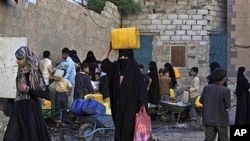
Across the Red Sea in war-torn Yemen, residents of the capital Sana'a say government water comes to their houses "so infrequently” they are "forced to pay to haul it in from outside the city by truck."
United Nations Development Program statistics also indicate that levels of Yemen's 21 main aquifers are falling by seven meters per year on average, leading some experts to speculate the country will be completely out of potable water within five to 10 years.
Hakim Almasmari, Editor in Chief of the Yemen Post, says "less than 10% of the country gets its water from the government" and that “Sana'a could be the first capital in the world to run out of water." He blames poor infrastructure and the culture of Yemen's ubiquitous narcotic qat tree for the problem.
"First of all, there's no real infrastructure that can help in using the rain-water appropriately, and so everything that is being used in Yemen is the underground water," he says. "Seventy percent of that water goes to qat plantations, and Yemenis seem to be growing it more and more every day."
To the north in Lebanon and Syria, where it rains more frequently, poor infrastructure prevents capture of considerable quantities of rainwater, which ends up in the sea. Professor Louis Hobeika, who teaches economics at Lebanon's Notre Dame University, also points out that water is priced inexpensively, which encourages people to squander it.
"People abuse the consumption of water because the price is low, and there is no metering system," he says. "For example, in Lebanon we don't have meters in the use of water. We pay an annual fee and it's independent of how much water you consume, which is frankly ridiculous. It pushes people to over-consume and to waste it."
An exacerbating factor
Although Lebanon and Israel have a history of quarreling over water from southern Lebanon's Litani River, Hobeika stresses that bad political relations between most countries in the region tend to exacerbate the crisis wherever it persists.
"Economic and political relationships among countries in the Middle East is usually bad and, therefore, water is one of the sources of conflict in the region," he says. "The water of the Litani River in Lebanon is one of those important examples of current and especially potential conflicts between us and Israel."
correction 12/10/11 - 'downriver' changed to 'upriver' in 4th paragraph