



News / Africa

More Resignations From Tunisia's Interim Government

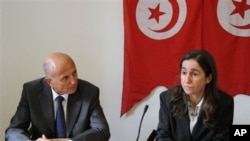
General secretary of the Tunisian PDP opposition party Maya Jeridi, right, and opposition leader and lawyer Ahmed Nejib Chebbi, left, attend a press conference, in Tunis, January 05, 2011
TEXT SIZE - +

Two more Cabinet ministers, including a prominent opposition party leader, have resigned from Tunisia's interim unity government following weeks of protests against the caretaker administration.

Ahmed Nejib Chebbi,  founder of the opposition Democratic Progressive Party, announced his departure Tuesday from the job of local development minister.  He expressed dissatisfaction with the direction of the interim government. Chebbi and other opposition figures joined the interim government following the January ouster of longtime President Zine al-Abidine Ben Ali as part of efforts to move the country toward democracy.

Higher education minister Ahmed Ibrahim also quit the government Tuesday.  He heads the Ettajdid opposition party.  On Monday, Tunisia's official news agency announced the departures of the planning and technology ministers.

Prime Minister Mohamed Ghannouchi resigned on Sunday, a day after clashes at anti-government demonstrations left at least three people dead.  Demonstrators have criticized the make-up of the interim government, saying it is too close to the former government of Mr. Ben Ali.

Also Tuesday, the human rights group Amnesty International called on Tunisia's interim government to investigate incidences of violence and make sure those responsible are held accountable.  

An Amnesty International report on the revolt found that security forces shot fleeing protesters and fired ammunition at bystanders.

The director of the group's Middle East and North Africa program Malcolm Smart said Tuesday that Tunisian security forces acted with "reckless disregard for human life" in many cases.  He added that the interim government must provide victims with "justice and reparation.".

Some information for this report was provided by AP, AFP and Reuters.

Follow our Middle East reports on Twitter
and discuss them on our Facebook page.

You May Like

India, China Pledge to Overcome Border Tensions

Indian prime minister and Chinese premier attempt to move past tense standoff in the Himalayas during Delhi talks More

Burmese President Opens US Visit with VOA Town Hall Meeting

Ahead of his meeting with President Obama Monday, Thein Sein answered questions on human rights and economic development in his country More

Video Washington Week: Focus on Burma, US Government Scandals

President Thein Sein visits the White House on Monday, Congressional probes of multiple scandals are continuing More

This forum has been closed.
Comments
     
There are no comments in this forum. Be first and add one

Featured Videos

Your JavaScript is turned off or you have an old version of Adobe's Flash Player. Get the latest Flash player.
Video

Video Boston Bomber Spent 6 Months in Russia’s Most Violent Republic

The news of the Boston Marathon bombings circled the globe, and resonated here in Dagestan, a majority Muslim republic in Russia, on the shores of the Caspian Sea. Last year, Tamerlan Tsarnaev, the older of two brothers suspected of the bombings and a long-time Boston resident, returned to Dagestan, where he had lived for a year during his youth. Dagestan was the land of his maternal ancestors. But in the last two years, this republic of 3 million people has gained notoriety as the region with the highest level of political and religious violence in all of Russia. VOA's James Brooke reports from Makhachkala, Russia.