


News / Africa

NATO Bombs Libyan Satellite Dishes

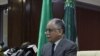
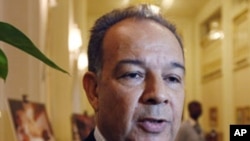
Khaled Bazalia, Libyan English TV director, speaks to the media about the NATO bombing of Libyan TV, in Tripoli,  July 30, 2011
Khaled Bazalia, Libyan English TV director, speaks to the media about the NATO bombing of Libyan TV, in Tripoli, July 30, 2011
TEXT SIZE - +

NATO says it has bombed three Libyan satellite dishes in the capital, Tripoli, in an effort to prevent Libyan leader Moammar Gadhafi from using state television to intimidate civilians.

But the Libyan Broadcasting Corporation condemned the attack Saturday, saying three employees were killed and 15 more wounded.  An LBC official said the channel is not a "military target" and its employees were doing their jobs as journalists, posing no threat to civilians.

A NATO spokesman, Colonel Roland Lavoie, said the strike was "necessary," because he said Gadhafi used television broadcasts to "oppress and threaten" the Libyan people and incite attacks against them.  He said the strike on the satellite dishes was carried out after "careful planning" to minimize the risk of casualties or long-term damage to television transmission capabilities.

Libyan state television remained on the air following the strike.

NATO has been conducting air raids in Libya since March under a United Nations mandate to protect Libyan civilians from Mr. Gadhafi's forces. The Libyan leader has been trying to crush a rebellion against his 41-year rule.

News reports said several explosions rocked Tripoli Friday night.

Earlier Friday, thousands of Libyans turned out in rebel-held Benghazi for the funeral of the opposition's military chief, who was shot dead in the city Thursday under mysterious circumstances.

Abdel Fattah Younes had been part of Libyan leader Moammar Gadhafi's inner circle before joining the rebels earlier this year.

The opposition National Transitional Council (TNC) says it is investigating the killing. It has said only that Younes was gunned down on his way to Benghazi, where he had been summoned to discuss "a military matter."

Earlier, rebels said they had detained Younes on suspicion his family may still have ties to Gadhafi's government.

Some information for this report was provided by AP and Reuters.

Follow our Middle East reports on Twitter
and discuss them on our Facebook page.

You May Like

India, China Pledge to Overcome Border Tensions

Indian prime minister and Chinese premier attempt to move past tense standoff in the Himalayas during Delhi talks More

Burmese President Opens US Visit with VOA Town Hall Meeting

Ahead of his meeting with President Obama Monday, Thein Sein answered questions on human rights and economic development in his country More

Video Washington Week: Focus on Burma, US Government Scandals

President Thein Sein visits the White House on Monday, Congressional probes of multiple scandals are continuing More

This forum has been closed.
Comments
     
There are no comments in this forum. Be first and add one

Featured Videos

Your JavaScript is turned off or you have an old version of Adobe's Flash Player. Get the latest Flash player.
Video

Video Boston Bomber Spent 6 Months in Russia’s Most Violent Republic

The news of the Boston Marathon bombings circled the globe, and resonated here in Dagestan, a majority Muslim republic in Russia, on the shores of the Caspian Sea. Last year, Tamerlan Tsarnaev, the older of two brothers suspected of the bombings and a long-time Boston resident, returned to Dagestan, where he had lived for a year during his youth. Dagestan was the land of his maternal ancestors. But in the last two years, this republic of 3 million people has gained notoriety as the region with the highest level of political and religious violence in all of Russia. VOA's James Brooke reports from Makhachkala, Russia.