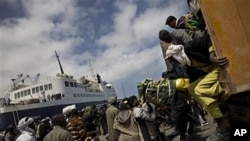
NATO and the European Union say they are doing what they can to help African migrants in trouble at sea amid calls by the United Nations to intervene.
As hundreds of migrants continue to set sail from North Africa to Europe, and the death toll of casualties climbs. Questions are also mounting about efforts to save those foundering at sea.
Britain's Guardian newspaper has reported that African survivors of a troubled vessel accused European and NATO units of ignoring their calls for help. And on Tuesday, the United Nations refugee agency appealed to NATO and the European Union to intervene to help save lives, following reports that a boat carrying hundreds of Africans sank off the coast of Italy.
At a press conference on Tuesday, NATO spokeswoman Carmen Romero said that while NATO's mandate was to protect civilians in Libya, the alliance was also helping those at sea.
"While they are carrying out that mandate, ships under NATO command will always respond to calls from ships in distress. This is the duty under the Law of the Sea and to suggest that our ships' captains would do otherwise is unfair and ... disrespectful," he said.
For example, Romero said that in March, NATO helped two foundering ships carrying 500 people. She also said there were allegations the Libyan government recently forced migrants into at least one boat which sank soon after.
An EU spokesman said the European FRONTEX border protection agency had also rescued those at sea. "This is the Hermes program and we have seen it in action just this weekend in [the Italian island of] Lampedusa where scores of people were saved off the coast of Lampedusa," he said.
Analyst Hugo Brady, of the London-based Center for European Reform, says the sea migration from Africa to Europe has been going on for years. But the numbers have spiked with the recent Arab uprisings.
"The reason why the Arab Spring has created so much instability in migration terms is ... obviously people are escaping a very difficult situation," said Brady.
Brady says the turmoil in Tunisia, Libya and elsewhere also means these countries no longer patrol their coastlines to prevent migrants from heading to Europe.
The plight of these sea migrants is part of a larger European debate about how to deal with those fleeing the Arab turmoil. For example, there are discussions on tightening Europe's open-borders Schengen agreement.
David Nichols, senior executive for rights group Amnesty International in Brussels, says Europe should be welcoming these migrants, not turning them away.
"All of the rhetoric coming from the EU is completely skewed and it has been completely skewed for a long time now towards trying to prevent people from crossing into Europe, from crossing European borders. Nothing at all about actually helping people who are in a desperate situation," he said.
European Union ministers are meeting later this week to discuss the African migration dilemma and how to deal with it.
NATO, EU Defend Record of Saving African Migrants