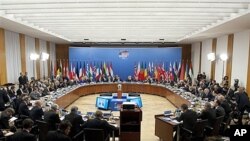
NATO's secretary-general says the alliance needs more precision aircraft to destroy Libyan weapons hidden within the civilian population. Anders Fogh Rasmussen made remarks at a NATO foreign ministers meeting that is taking place amid divisions over the Libya campaign.
Speaking at a press conference at the start of the two-day foreign ministers meeting in Berlin, Rasmussen said the NATO campaign in Libya needed more precision fighters to adapt to changing strategies by the Libyan regime.
"Now they hide their heavy arms in populated areas where before many targets were easier to get to. To avoid civilian casualties, we need very sophisticated equipment. So we need a few more precision fighter ground attack aircraft for air-to-ground missions." he said.
Rasmussen said he was confident NATO would get them, although there have been no firm pledges to date. The United States, which has such aircraft, has reduced its role in the campaign although Rasmussen says it continues to contribute to the mission.
He said all participants in the Libyan mission agreed on a set of objectives, including that Libyan soldiers, mercenaries and snipers must withdraw and that the regime allow for safe and unhindered humanitarian access.
The foreign ministers meeting comes amid divisions over how forceful the NATO air campaign in Libya should be and whether to arm Libyan rebels.
U.S. Secretary of State Hillary Clinton said the world must increase its support for the Libyan opposition. Speaking to reporters alongside German Chancellor Angela Merkel, Clinton said Libyan leader Moammar Gadhafi must go.
"We are also sharing the same goal which is to see the end of the Gadhafi regime in Libya and we are contributing in many ways to see that goal realized," she said.
But Rasmussen again distanced himself from arming the Libyan rebels on Thursday, saying it was NATO's mandate to also enforce the arms embargo on Libya. He said that while NATO members were committed to protecting civilians in Libya, ousting Gadhafi demanded a political track.
"I fully agree there is no military solution to the problems in Libya. What we need to ensure a long term sustainable solution is a political process that responds to the legitimate demands of the Libyan people," he said.
Rasmussen did not respond directly to the question of whether NATO was advising Libyan rebels on military strategy. He said the alliance had contacts with the opposition but it was up to them to decide day-to-day strategy.
NATO Nations Commit to Ending Gadhafi Rule