



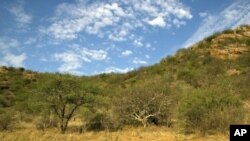
The most extensive study ever of biodiversity confirms what scientists have long believed, that natural ecosystems are healthier and more resilient when they support a large variety of plant life.
Reported in the Journal Science, this globe-spanning research finds that abundant forms of plant life keep soils more fertile and productive, and help to buffer ecosystems against the stresses of a changing climate.
The study focused on semi-arid ecosystems which cover 40 percent of the planet and support 40 percent of the human population. Co-author David Eldridge, with the School of Biological, Earth and Environmental Sciences at Australia’s University of New South Wales, says these dry lands are also among the ecosystems most at risk “from changes in management, changes in rainfall, changes in climate.”
An international team of scientists studied dry lands on every continent, except Antarctica. Eldridge points out that on each, they marked out 30-by-30-meter plots, inventoried the plant life within and measured how it cycled carbon, nitrogen and phosphorus, elements considered essential for life on earth.
“We also measured other attributes that we thought might be related, things like temperature, soil texture... how much sand or clay the soil has got in it, slope, latitude, longitude, all those attributes and used a modeling system to be able to pick out what some of the drivers were.”
Eldridge says while there were differences among the areas - from the dry woodlands in Western Australia to the high alpine grasslands in Chile - the overall findings were remarkably similar.
“Even with this huge diversity of different types of plant communities, the fact that when we analyzed our data from more than 200 sites, that even in these really diverse communities, diversity of plants came out as being a highly significant driver of how functional the soil was.”
And that wide variety of plant species was even more important than other factors, Eldridge says, such as annual rainfall and microbes in the soil. Loss of biodiversity reduces those services the ecosystem can provide.
“If we go from a system where we have a lot of species to very, very few species, then we know that the ability of the soil to produce carbon, to allow water to infiltrate to hold together, actually break down.”
The changing climate is also likely to reduce plant diversity and increase the areas affected by the desertification now underway in many developing countries. Eldridge says, for example, in a warmer world, sand content in soils would be expected to rise, lowering its productivity.
"What this shows is that anything that results in increased temperatures is ultimately going to reduce the functionality of dry land soils. Our diverse community of plants is providing a buffer against increased climate change.”