


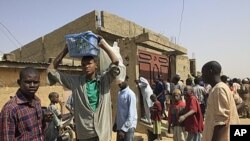
A series of bomb attacks by Nigeria's radical Islamist sect Boko Haram is challenging President Goodluck Jonathan's government. The pace of the bombings has picked up in recent weeks, with attacks on police stations in the northern city of Kano and a Christmas Day suicide bombing at a Catholic church near the capital, Abuja.
In the entry way of St. Theresa's church in Madalla, one can see worshippers coming in for Sunday mass just as they did on Christmas Day. But outside in the churchyard a scene of destruction remains - twisted metal, chunks of concrete, burned out trees and a huge hole in the road where a vehicle was stopped and detonated by the suicide bomber who killed so many people.
St. Theresa's pastor, Father Isaac Acha, calls on worshippers to pray for the bomber as well as his victims.
"Pray [to] God for forgiveness in our hearts, especially on those who have inflicted injury, pain into our lives," he said.
Outside the church, Father Acha praises the Muslims of Madalla for their outpouring of sympathy and support during the church's time of grief. He says Muslims and Christians here have always considered themselves one community.
"That relationship between Christians and Muslims, especially in the middle belt of Nigeria, you see in a family of five - three are Muslims, two are Christians. In a family of six, four are Christians, two Muslims. And this is how it has been, and we eat and drink together," he explained.
Father Acha blames successive governments for ignoring the growth of Islamic radicalism in Nigeria during the past 10 years.
"Boko Haram came shortly after the political regime of some governments, feeling Nigeria should be an Islamic state introducing Sharia law in their states. Gradually, before we know it, there was this group trained, and security men were equally aware of them. And nobody took them serious," Acha recalled. "They came as a political organ and now it has turned to become a religious problem."
Thirty kilometers away, at Abuja's main mosque, the message is one of tolerance. Islamic cleric Huseyn Zakaria Mohamed agrees with his Catholic counterpart that the rise of sectarian tensions has been tolerated, and in some cases encouraged, by those in power.
"Left to the Muslims or the Christians without interferences - without actually people sponsoring them to fight and kill each other and maim each and destroy their properties - they are brothers and sisters and keepers to one another," Mohamed said.
He says most Nigerian Muslims reject Boko Haram's brand of radical Islam.
“We don't preach 'fight the Christians' in the mosque. We don't do that. A Christian has rights in an Islamic state. In Nigeria," Mohamed stated. "Christians must have their right to worship.”
At St. Theresa's, parishioners stand on the church steps after Sunday mass surveying the wreckage left by the Christmas Day blast. They say they wonder what the suicide bomber was thinking. If his goal was to strike a blow against Christianity, they say he failed. The damage to the church was only superficial, and of the 44 people killed, 26 were church members. The other 18 were passersby and neighbors - some of them Muslims.