



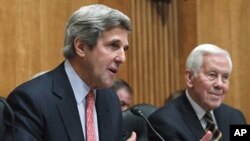
A leading U.S. senator says despite the killing of Osama bin Laden by U.S. Special Forces, a rapid pullout of American troops from Afghanistan would be unwise.
Senate Foreign Relations Committee Chairman John Kerry described the killing of terrorist leader Osama bin Laden as a “game-changing” opportunity in the war on terror, but not an event that should trigger a rapid U.S. exit from Afghanistan.
“Let me be clear," Kerry said. "I do not know of any serious policy person who believes that a unilateral precipitous withdrawal from Afghanistan would somehow serve our interests or anybody’s interests. I do not believe that is a viable option.”
Instead, the Massachusetts senator suggested striving for the smallest U.S. presence possible that contains terror threats while preparing Afghanistan for the 2014 target date for withdrawing American forces. How to achieve those goals was the focus of a hearing on Capitol Hill.
The ranking Republican on the Foreign Relations Committee, Senator Richard Lugar of Indiana, framed the issue this way.
“The question before us is whether Afghanistan is important enough to justify the lives and massive resources that are being spent there, especially given our nation’s debt crisis," Lugar said.
U.S. expenditures in Afghanistan total roughly $10 billion a month, far exceeding resources devoted to fighting terrorism in other countries such as Yemen, where threats to American security are widely viewed as greater than those of Afghanistan.
Testifying at the hearing was defense expert Stephen Biddle of the Washington-based Council on Foreign Relations. Biddle said narrowly comparing Afghan-based terror threats to those posed by other nations misses a larger point: that the United States has critical interests involving Afghanistan’s neighbors, especially Pakistan.
“The threat emanating from places like Yemen, Djibouti, or Somalia is of conventional terrorism," Biddle said. "The downstream threat associated with failure uniquely in South Asia is the potential collapse of a nuclear-armed and unstable state that is facing an internal insurgency of its own in Pakistan
Another analyst said there are no quick, easy, or low-cost options when it comes to Afghanistan. David Kilcullen is a senior fellow at the Center for a New American Security.
“The mission of the moment now in Afghanistan is to make the country stable enough that we can reduce the U.S. footprint to a sustainable level without an unacceptable drop in security," Kilcullen said. "And I think that is a relatively low bar [modest expectation]. But just because it is a low bar strategically does not mean that it is not going to cost a lot of resources to get there.”
Several senators expressed fatigue and dismay over the length of the war in Afghanistan and its continuing costs.
Democratic Senator Barbara Boxer of California had this response to an often-heard argument that U.S. objectives in Afghanistan and Pakistan are hampered by suspicions in both countries that the United States will disengage from the region.
“Pakistan is now the second-largest recipient of U.S. foreign assistance," Boxer said. "And the U.S. has spent more years fighting in Afghanistan than any other war. If anybody says we are not committed to the region, what about the 100,000 forces we still have on the ground [in Afghanistan], half a trillion dollars we have spent, $10 billion a month?”
Senator Kerry said there is no military solution in Afghanistan, but a negotiated political solution involving the Afghan government, militants, and the international community may be possible.