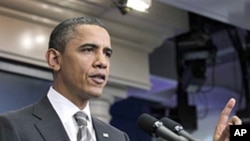
President Barack Obama is defending his compromise with Republicans to extend tax cuts that began under his predecessor, George W. Bush. Most criticism of the deal has come from the president's own Democratic Party.
At a hastily-arranged news conference Tuesday, President Obama gave an unusually emotional response to fellow Democrats who say he gave in too quickly to Republicans on the tax issue.
"Take a tally," said President Obaama. "Look at what I have promised during the campaign. There is not a single thing that I have said that I would do that I have not either done or tried to do. And if I have not gotten it done yet, I am still trying to do it."
The president agreed with Republicans to extend for two years the Bush-era tax cuts for all Americans, including the wealthiest two percent. The deal would also continue unemployment benefits for 13 months and reduce payroll taxes for workers to encourage employers to start hiring.
Many Democrats are especially frustrated about the upper-income tax cuts, which Mr. Obama has consistently said he opposes.
Analysts say the deal could cost an estimated $900 billion over the next two years.
The president said most Americans agree with him that extending tax cuts for the wealthy is a bad idea, but politically, he had no choice. He said he could not convince Republican lawmakers that they should extend tax cuts for the middle class without doing so for the rich.
"But the issue is not me persuading the American people-they are already there," said mr. Obama. "The issue is how do I persuade Republicans in the Senate, who are currently blocking that position. I have not been able to budge them."
Mr. Obama told reporters the deal will prevent a long political battle that would have led to further economic misery for many Americans.
"Because of this agreement, 2 million Americans who lost their jobs and are looking for work will be able to pay their rent and put food on their table," he said.
The agreement will require passage in both the Senate and the House of Representatives. Some Democrats have vowed to block the deal, while the top Republican in the Senate, Minority Leader Mitch McConnell, is backing it.
"I think the vast majority of the members of the Republican conference of the U.S. Senate feel that this is a step in the right direction, an important step to take for the American people, and I think the vast majority of my members will be supporting it," said McConnell.
Mr. Obama said agreeing to the deal was the only way to avoid inflicting further damage on the U.S. economy.
He said he remains opposed to high-end tax cuts, and will fight to end them when they expire in two years.
Obama Defends Tax Compromise With Republicans
- By Kent Klein