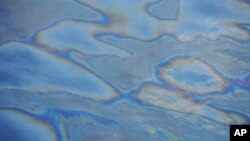
Oil and water don't mix, as the old saying goes. That's as true in the ocean as anywhere. However, oil in the ocean can also be a lethal combination for wildlife. Spills from tankers, pipelines or an offshore platform - as is the case in leaking Deepwater Horizon platform in the Gulf of Mexico - can affect thousands of square kilometers of sea and land. And the effects can last many years after it seems the oil is cleaned up.
"Right now we have immediate short-term impacts and possible implications for wildlife and habitats being directly coated by oil," notes Doug Inkley, senior scientist with the National Wildlife Federation. "But the longer term impacts are the toxic effects and the residual effects that could last for years. In the wreck of the Exxon Valdez in Prince William Sound in Alaska, it's now 20 years later and we still have some species that are not recovering or have not completely recovered to pre-wreck conditions."
Until the Exxon Valdez tanker spilled more than 260,000 barrels of oil in 1989, the United States' worst oil disaster had been off California's Santa Barbara coast in 1969. It coated the water and western California shore with nearly 4,800 barrels of oil that eventually spread across 1300 kilometers, killing thousands of marine birds, mammals and fish.
"We have to be concerned about any of the birds that land on the water," says Inkley. "We have to be concerned about the entire marine eco-system because this oil is toxic to the phytoplankton, the zooplankton, the very base of the food chain that all the animals further up the food chain are dependent upon."
The 1969 California oil spill is credited with having sparked the modern environmental movement. But injury to marine wildlife is just one part of the story. Oil spills can have devastating effects on a region's economy. Blighted beaches do not attract tourists, and the fishing industry in the vicinity of an oil spill can be nearly wiped out. In Louisiana, areas where fishermen would normally trawl for shrimp and trap crabs have been shut down as the oil slick threatens to contaminate fishing waters.
"It is an ecological disaster," says NWF's Inkley. "It's going to change the livelihood of people probably forever. And what we need to do is recognize that we're all in this together. And to the extent that we're using oil and gas ourselves, we're probably contributing to the problem."
Environmental groups like the National Wildlife Federation propose the United States needs to convert to renewable fuels, because accidents and oil spills will continue to happen. And these days, even industry groups like the American Petroleum Institute agree on the need for renewables - in theory. However in practice, says API senior economist Sara Banaszek, oil remains the single largest source of energy worldwide.
"Right now, today in this country, less one percent of our energy is coming from wind and solar," says Banaszek. "It's growing very rapidly but it's growing from a very small base. 60 percent of our energy is coming from oil and natural gas. That's down from 25 years ago, maybe 70-something percent was coming from oil and natural gas. And it's forecast to continue declining down to 50-something in the future."
And despite the potential magnitude of environmental havoc in the Gulf, says Banaszek, accidents like that at the Deepwater Horizon platform are extremely rare. "We haven't had an even of this sort of size or magnitude in about 40 years and we've been operating in the Gulf of Mexico since the 1940s."
Elsewhere in the world, however, there have been more accidents. Last year in Australia, an oil well owned by a Thai company leaked for ten weeks into the Timor Sea before being plugged. And, says Doug Inkley, these spills do not clean up easily.
"The idea that we can effectively clean up an oil spill is really a myth, it's a fabrication. When you look at the size of this oil spill, when you look at the size of the Exxon Valdez oil spill, only 14 percent of the oil was ever recovered."
It remains to be seen exactly how this latest oil disaster in the Gulf of Mexico will affect U.S. energy policy, given that the oil and gas industry also provides hundreds of thousands of American jobs.