


In the Soviet days, it was clear where Moscow stood. Over the last two weeks, the Kremlin has been all over the map on Libya.
It is sometimes hard to remember that only two weeks ago, Russia abstained in the United Nations vote authorizing the use of military force in Libya.
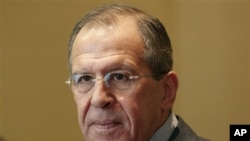
Within days, Russian President Dmitry Medvedev was lecturing visiting American Defense Secretary Robert Gates about reports from Tripoli that allied bombing was causing heavy civilian casualties. Then, Russia’s foreign minister Sergey Lavrov warned Western nations not to arm Libya’s rebels.
This week, Russian congressmen appeared on television predicting Western defeat in Libya. And on Friday, Young Russia, a pro-Kremlin youth group, demonstrated outside the U.S. Embassy in Moscow, demanding that President Barack Obama return his 2009 Nobel Peace Prize for American involvement in wars in Libya, Afghanistan and Iraq.
Part of this can be attributed to anti-Americanism, a mood that has ruled Russian public opinion largely uninterrupted since the end of World War II. In a public opinion poll taken just before the Western military intervention in Libya, 65 percent of Russians agreed with the statement that the U.S. is an aggressor seeking to control all countries of the world.
But there is also a new twist.
Russia depends less and less on the West for trade and investment. Roland Nash, a strategist for Verno Capital, an Arab supported fund that invests in Russia, says capital flows are shifting Russia’s foreign policy.
"The West is just not that important, not so overwhelmingly important as it was several years ago for Russia. And they have been really reorienting to where the growth is coming from, and what is driving a lot of what is important in Russia. And that is Asia, China in particular, the Gulf, and other emerging markets, including South America and Africa," he said.
Increasingly, Russia trades and identifies with countries that historically see themselves as victims of aggression by Western powers, according to Nash, a native of Britain. "Ten years ago, the West was a completely dominant economic partner, China was irrelevant. Over the last 10 years, trade with China, for instance, has multiplied by a factor of 10. Now China is a bigger trading partner than Germany," Nash said.
Many analysts see Russia as seeking a post-Imperial role in the world. No longer a superpower, it has decided to try to maintain good relations with key countries around the globe. In Soviet days, Russian diplomats routinely vetoed Security Council resolutions supported by the United States. By abstaining in its UN vote, Russia joined China, Brazil and India.
Fyodor Lyukanov edits Russia in Global Affairs magazine. "Russia does not see itself any more as part of a global power which should participate in everything. Rather, the country focuses interests much more on spheres of most vital interest," Lyukanov said.
And increasingly those spheres are in Africa, Latin America and Asia - regions that are bystanders on Libya. "Russia is far and away the world’s largest producer of natural resources, and Asia is the biggest consumer. So it is really not surprising that the economic relations are going to get a lot stronger," Nash said.
On Friday, Mikhail Margelov, the Russian government’s top representative to Africa, gave a series of interviews, predicting that Libyan leader Moammar Gadhafi would be out of power by June. The Russian official said he was sending aides to Benghazi to forge contacts with the opposition.
At the end of the day on Libya, Russian officials may have tried to please everyone, but ended up pleasing no one.
On Libya, Russia Shows New, Non-Aligned Foreign Policy
- By James Brooke