



News / Asia

Overgrazing Linked to Locust Outbreaks

Nutrient-poor land in Inner Mongolia proves fertile for swarms

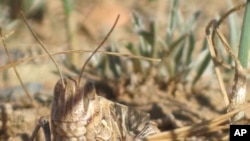
A locust in its grassland habitat - a heavily-grazed field in Inner Mongolia.

Multimedia

Audio
TEXT SIZE - +

Livestock overgrazing can lead to outbreaks of ravenous locusts, according to a new study.

Overgrazing is already known to lead to erosion and reduce the fertility of pasture lands.


But the researchers were surprised to find overgrazed, nutrient-poor land in Inner Mongolia was actually fertile ground for a species of locust native to the region.

"It's a counter-intuitive result," says Arianne Cease at Arizona State University, lead author of the study published in Science.
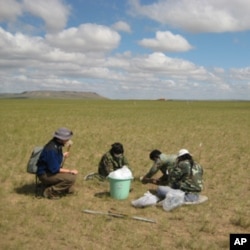
Arianne Cease, left, and field assistants collect grass in a heavily-razed field to test for plant nitrogen, carbon and protein content.

Cease and her team thought the locusts they studied might not form swarms if they had access to well-fertilized vegitation which was high in protein.

Locust killer

“What we found was that the high-protein diet was actually very deleterious to this locust. It caused most of them to die." On the other hand, she says, they found this particular locust thrived on low-protein grasses found on eroded, overgrazed land. "They actually need what's typically thought of as a poor-quality food to build up to high population levels."  

University of Sydney biologist Stephen Simpson notes that, as the Eurasian grasslands have been degraded by  livestock grazing and erosion, locust outbreaks have increased.

"The authors have shown that they are indeed linked," he says. "Understanding this relationship will help in the development of land management practices that reduce the locust threat."

Fertilizing an over-grazed field to raise plants’ protein levels might actually help control this insect, according to Cease's research.

Different impacts

However, the same may not be true for all locusts, cautions Keith Cressman, chief of locust outbreak forecasting at the U.N. Food and Agriculture Organization.

Researchers have found just the opposite effect in desert locusts, which Cressman says are perhaps the most destructive. “When the insects eat leaves high in [protein], they will reproduce more, they will grow faster, they will increase in number, they will survive better and they’re just a healthier locust.”

Cressman says the relationships between livestock, land and locusts are complex and differ from place to place. More research will be needed to sort them out completely.

Cease plans studies in Africa on how grazing practices affect other species of locusts.

You May Like

Pakistan Reiterates Opposition to US Drone Strikes

Day earlier US President Barack Obama justified 'constrained' drone usage to save lives More

Study Identifies Risks of Human Spread of H7N9 Bird Flu

Study suggest that international measures to contain the H7N9 influenza, in the event of severe outbreak, will need to be targeted in Asia More

Violence Continues in Conakry Over Upcoming Elections

Opposition has called for boycott of elections More

Video Syria's Civil War Fuels Violence in Iraq

Analysts say al-Qaida-linked militants are flowing back and forth from both countries More

Video Star Trek Influence Lives Long and Prospers

As new movie thrills, many are once again discussing the iconic franchise's influence on society, science and technology More

OECD: Developing Green Cities Key to Sustainable Future

OECD suggests strategies to mitigate rapid growth, industrialization in urban centers, which produce about two-thirds of greenhouse gas emissions More

This forum has been closed.
Comments
     
There are no comments in this forum. Be first and add one

Featured Videos

Your JavaScript is turned off or you have an old version of Adobe's Flash Player. Get the latest Flash player.
Video

Video Volunteers Help Revive LA's Concrete River

The Los Angeles River is a concrete drainage channel through much of its 80-kilometer length. It channels waste-water from storm drains and has become a receptacle for much of the city's trash. But as Mike O'Sullivan reports, the river is slowly being restored with the help of volunteers, who take part in an annual clean-up.