



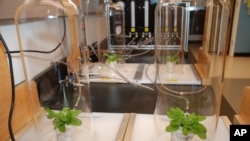
Talking plants might sound like characters in a fairy tale. But recent scientific studies have revealed that plants communicate with each other and with other living things in a surprising number of ways. To understand them, scientists say, we just have to learn their language. Farmers are especially interested in what plants have to say.
At the University of Alberta in Canada, Ecology Professor James Cahill studies plant roots. He's been doing that for years, and one of the things he's learned is that while plants can't walk away from trouble, they can still respond to it, and to a wide range of stimuli, both good and bad.
"Plants are able to communicate with all sorts of organisms. They can communicate with giant bacteria, with other plants and with insects. They do this chemically," said Cahill.
Plant scientists are just beginning to understand this chemical "language." Cahill says studies have shown, for example, that plants can evaluate conditions in their immediate environment and take appropriate actions. But is that a sign of intelligence?
"I don't think plants have brains, but we do see plants that are able to integrate information. They can respond to nutrients and competitors," Cahill noted. "We as people need a brain to show these complicated behaviors, but a brain isn't needed by all species to show complicated behaviors."
Plants can react to sounds. University of Missouri chemical ecologists Heidi Appel and Jack Schultz recorded the subtle chewing noises of a caterpillar eating a plant. Being eaten stimulated the plant’s defenses. But when the sounds were played to another plant that was not being eaten, they triggered a defensive response.
Plants have an ability, for example, to signal distress, caused by anything from temperature extremes to an insect attack. Schultz said when a plant senses that it's being eaten, it releases a chemical vapor that alerts other plants nearby.
"Their language is a chemical language, and it involves chemicals that move through the air that are volatile, and most of all are odors that we are familiar with," Schultz explained.
Schultz says these chemicals move through the air in very low concentrations and so far they have been identified only in laboratory settings. He says scientists first discovered this phenomenon when they exposed a group of plants to an insect that eats them.
"All plants responded to the attack by changing their chemistry to defend themselves," Schultz recalled. "But we were quite surprised to find that nearby plants also changed their chemistry to defend themselves, even though they were not part of the experiment."
Studies have also shown that when plants are under attack release aromatic chemicals. Those chemicals attract friendly insects that attack the bugs eating the plant. Schultz says this chemical signaling can be easily detected by one of nature's most sophisticated sniffers, dogs.
"Some vineyards in California are using dogs to sniff vines that have pest infestations. So it can be done if you have the right nose," Schultz noted.
Schultz and his colleagues are working to develop an electronic version of a dog's nose. When taken into a farmer's field, it would help growers apply pesticides only to those plants under insect attack.
In the end, plants' ability to communicate their needs - and our ability to understand them - could help farmers reduce the use of toxic chemicals, cut operating costs and limit damage to the environment.