



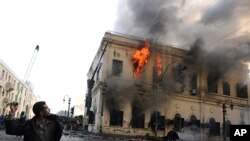
Cairo reporter Edward Yeranian tells us about the scene in Tahrir Square, where he was briefly caught between police and protesters.
Clashes between Egyptian police and stone-throwing protesters have rolled into a second day, leaving eight people dead and more than 300 wounded.
Thick traffic flows slowly on the bridge over the River Nile from the northern side of Cairo's Tahrir Square, as a crowd of young men throws stones at military police on the road below.
Billowing plumes of black smoke rise into the sky over the square from a burning building. Passersby say protesters started the fire. Fire crews did not come to extinguish the blaze.
Filming the skyline draws an angry response from one motorist, who shouts, "Spy! Spy! Catch that spy!" A policeman walking nearby does nothing.
Along the riverside highway, clusters of young men, some with bandanas covering their faces, run down a bridge ramp looking frightened. A line of military police is close behind them.
The police appear to be unarmed, but they are holding thick metal bars or pipes in their hands. One swings his bar at a protester, grazing him lightly, then stops when he sees a foreign correspondent.
A second policeman rifles through a camera bag, then throws it to the ground when he finds no camera inside. "You cannot film us," he orders. One of four other policemen standing there appears enraged. "They're throwing stones at us," he yells at a reporter.
A cat-and-mouse game plays out elsewhere as young people try to circle behind police lines and return to the central part of Tahrir Square, which is mostly empty.
Witnesses say police put up barbed wire near the parliament building to keep protesters from approaching. A sit-in in front of the parliament and the prime minister's office was broken up Friday.
Late Friday and overnight, dozens of people were wounded and at least eight were killed during the sweep by military police that pushed demonstrators out of Tahrir Square.
Egypt's interim Prime Minister Kamal al-Ganzouri acknowledged to reporters that 18 people suffered bullet wounds, but he insisted that the police had no weapons.
It was difficult to confirm that assertion, but I saw no armed police Saturday morning.