Life in many parts of the Korean Peninsula is harsh, difficult and tense with the continued threat of conflict. Life in the region was also difficult more than 100 million years ago, when dinosaurs and other prehistoric creatures fought daily for their existence. Scientists have now gained a new perspective into life at that time with the discovery of a fossil near Seoul.
The small dinosaur fossil is called Koreaceratops. Michael Ryan, the curator and head of vertebrate paleontology at The Cleveland Museum of Natural History, is the co-author of the fossil study and describes the creature's likely appearance.
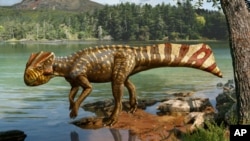
"Koreaceratops would have been a small (1.2 meter tall) herbivorous dinosaur. So it ate plants. If you can imagine what a large triceratops looked like, you took off the frill and the horns and shrunk it down, that is what little Koreaceratops looked like. It has a very parrot-like face, fairly deep but short. On the upper and lower jaws it actually has a beak at the front of its jaws. It has teeth behind those, but on the front there would have been a beak very much like a turtle beak or parrot beak," he said.
Like the more familiar Triceratops, Ryan says Koreaceratops lived much earlier and seems to be the precursor for its larger cousin.
"It occurred about 100 million years ago. Triceratops occurred about 65 million years ago. And it is about the size of a Labrador dog. If you shrunk that frill down on Triceratops so it is only a small little 'Beatle' (referring to the haircuts worn by the 1960s iconic rock band) brow projecting backwards and removed the horns over the eyes, that is very much what little Koreaceratops looked like," he said.
The specimen is the first horned dinosaur to be discovered on the Korean Peninsula. Fossils of dinosaurs have not typically been found in South Korea. More common discoveries have been dinosaur eggs and footprints.
Researchers have been looking for evidence of evolution from the smaller and older animals found in Asia to the larger specimens found in North America. Cleveland Museum's Michael Ryan says Koreaceratops fits into that gap.
"What Koreaceratops does is it fills a gap of a missing 20 million years between the last Asia specimens and the first of the North American large bodied ceratopsians," he said.
Remnants of the small plant eating dinosaur were not complete.
"The specimen is a partial skeleton minus the head unfortunately that was discovered near a local reservoir in and around Southern Korea. It was a series of large blocks that were collected from a quarry," said Ryan.
But what was recovered revealed many characteristics of Koreaceratops. The creature was a biped that could move quickly. The small front arms could have held plants while it ate. Its tail was shorter than most of its relatives, about the length of its body. But the tail had a unique shape.
"We have the backbone, the hips, the lower legs as well as most of the tail. And it is the tail that is unique.
There are a series of large spines that are called neural arches which project up from the top of the tail and would have actually supported a small frill-like structure, or actually a fairly large frill-like structure running down the tail," he said.
That structure might have been brightly colored so as the tail was moved, it could have appeared like a flag to signal others of the species and possibly to attract a mate. The structure may have also helped to cool the animal, and the tail also could have helped the dinosaur swim. Researchers think it spent part of its time hunting for aquatic food.
Results from the analysis of the Koreaceratops find were published recently in an online edition of the journal Naturwissenschaften: The Science of Nature.
Koreaceratops: Previously Unknown Dinosaur Discovered in South Korea