



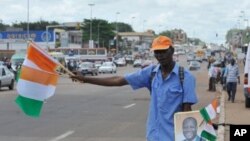
Ivory Coast president Alassane Ouattara is set to be inaugurated Saturday in the capital, Yamoussoukro. While his inauguration marks a symbolic end to six months of violent political crisis, Ouattara faces significant challenges to restoring national security.
Ivory Coast is still reeling from a post-electoral crisis that killed at least 3,000 people and displaced more than one million after former president Laurent Gbagbo refused to cede power to Ouattara following a November presidential poll.
The disputed November election sparked tensions still simmering after a 2002-2003 civil war.
As Ouattara takes office, analysts say restoring security and the rule of law after a decade of division are top priority on a to-do list that also includes such monumental tasks as economic recovery and national reconciliation.
International Crisis Group (ICG) West Africa Director, Gilles Yabi, says Ouattara does not currently have a real national army which makes security an even greater challenge.
Yabi says for the moment, the forces supporting Ouattara are primarily former rebels from the north who follow their former leader and Ouattara's current prime minister and defense minister, Guillaume Soro. Within this force, he says there remain some influential, rather autonomous northern commanders. Ouattara, he says, depends on these forces for his security and must work with them.
Yabi says these fighters, called the Republican Forces of Ivory Coast, are not yet fully integrated with the national security forces who supported Gbagbo, and internal tensions within them present a risk to Ouattara's presidency in the coming months.
The post-electoral crisis was only resolved in April when the Republican Forces, supported by French and U.N. troops, swept through Ivory Coast to the commercial capital, Abidjan, where they captured Gbagbo, who remains under house arrest in northern Ivory Coast.
Forces loyal to both men have been accused of atrocities and human rights abuses since the crisis began.
The humanitarian agency, the International Rescue Committee, says insecurity and sexual violence continue to plague Ivorian communities and hundreds of thousands of people in refugee camps in Ivory Coast and Liberia are too scared to return to their homes.
Ouattara has repeatedly vowed to hold perpetrators of abuses accountable, including those committed by forces loyal to him. This week, he formally requested that the International Criminal Court investigate crimes committed during the crisis.
Human Rights Watch West Africa Researcher, Matt Wells, says justice must also happen on a domestic level, a challenging task for a country where, as Wells says, the rule of law has been "in shambles" for the past decade, particularly in the north and far west.
"There has long been a lack of an independent judiciary, as well as police and gendarmes that respect rights as opposed to being abusers themselves," noted Wells. "Domestic prosecutions will be essential to ensuring complete justice. The ICC will take a few of the biggest cases, but for many of the grave crimes that were committed the domestic judiciary will be essential."
Credible and impartial prosecutions of perpetrators on both sides will be essential, analysts say, to restoring order in the country and solidifying Ouattara's claim that he is the president of all Ivorians.