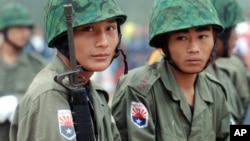
A new report says children are still recruited and used as soldiers in Burma, despite recent political reforms and calls by the United Nations to end the practice.
The report by the London-based Child Soldiers International says, although situation is improving, children continue to be in the ranks of the Burmese army, the border guard, and armed opposition groups.
The group says the government has not moved fast enough since signing an agreement with the U.N. last June aimed at identifying and releasing children from fighting. It also says two ethnic Karen rebel groups lack age verification procedures to prevent the practice.
Although the report acknowledges some human rights progress under the reforms implemented by President Thein Sein, it urges his nominally civilian government to give the issue of child soldiers the "highest priority."
Specifically, the group wants the U.N. to be allowed access to recruitment centers, military camps and training centers run by both Burmese government forces and rebel groups.
Nicholas Farrelly of the Australian National University tells VOA the problem is not what it was in decades past. However, there is still room for progress by both the government and rebel groups.
"There are plenty of indications in the report that things are better than perhaps they were sometime ago, but there are also so many parts of Burma where we don't really know the situation with respect to the recruitment of child soldiers," he said.
Myra Dahgaypaw, director of the U.S. Campaign for Burma, says the problem is worse among government forces. She tells VOA the Burmese army is relying on child soldiers because it is struggling to keep soldiers from defecting.
"[The army] wants to keep the quota of 400,000 troops, but they don't have 400,000 troops. They have to keep recruiting people because a lot of times they end up leaving the army when they go to the frontline. They don't want to keep fighting anymore," she said.
Except for the Kachin Independence Organization, most major ethnic rebel groups have reached cease-fire agreements, in recent years, with Thein Sein's government, which has enacted a series of political and economic reforms since coming to power in 2011.
Child Soldiers International says the cease-fires could offer the opportunity for the safe release of children, as well as the prospect of protecting children from future association with the groups.
The report by the London-based Child Soldiers International says, although situation is improving, children continue to be in the ranks of the Burmese army, the border guard, and armed opposition groups.
The group says the government has not moved fast enough since signing an agreement with the U.N. last June aimed at identifying and releasing children from fighting. It also says two ethnic Karen rebel groups lack age verification procedures to prevent the practice.
Although the report acknowledges some human rights progress under the reforms implemented by President Thein Sein, it urges his nominally civilian government to give the issue of child soldiers the "highest priority."
Specifically, the group wants the U.N. to be allowed access to recruitment centers, military camps and training centers run by both Burmese government forces and rebel groups.
Nicholas Farrelly of the Australian National University tells VOA the problem is not what it was in decades past. However, there is still room for progress by both the government and rebel groups.
"There are plenty of indications in the report that things are better than perhaps they were sometime ago, but there are also so many parts of Burma where we don't really know the situation with respect to the recruitment of child soldiers," he said.
Myra Dahgaypaw, director of the U.S. Campaign for Burma, says the problem is worse among government forces. She tells VOA the Burmese army is relying on child soldiers because it is struggling to keep soldiers from defecting.
"[The army] wants to keep the quota of 400,000 troops, but they don't have 400,000 troops. They have to keep recruiting people because a lot of times they end up leaving the army when they go to the frontline. They don't want to keep fighting anymore," she said.
Except for the Kachin Independence Organization, most major ethnic rebel groups have reached cease-fire agreements, in recent years, with Thein Sein's government, which has enacted a series of political and economic reforms since coming to power in 2011.
Child Soldiers International says the cease-fires could offer the opportunity for the safe release of children, as well as the prospect of protecting children from future association with the groups.