


A Britain-based rights group says the rights of minorities in Iran should be a key part of the country’s battle for democracy. Our reporter in London spoke to the head of Minority Rights Group International.
Mark Lattimer says the most systematic political repression in Iran today is targeted at minority groups.
"There are about 40 percent, maybe as much as a half of the Iranian population, who are made up of non-Persian minorities," said Lattimer. "And they are systematically excluded from positions of power in the country, they are denied any effective say in how the regions they inhabit are governed, and also their religious freedoms are very severely curtailed."
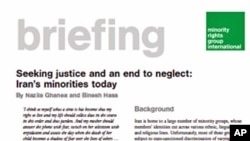
Minority Rights Group International published a report Wednesday entitled Seeking justice and an end to neglect: Iran’s minorities today.
The paper says persecution of Iran’s minorities is sanctioned by the state.
Iran’s constitution declares the state as Shia Muslim. Lattimer says those who practice other religions are marginalized. For example, he says, Sunni Muslims do not have a mosque in the capital, Tehran.
He says the Baha’i religious community perhaps suffers the most, but he says all non-Muslims are excluded from powerful political positions and also from spheres of power like universities.
Lattimer says the battle for rights is not easy.
"Any more demand for a bit more cultural freedom, or for religious freedom, is regarded as in some way attacking the security of the Iranian state and that is a really worrying development because it means that ordinary claims for basic human rights are somehow treated as though they are an attack on the Republic, an attack on the state and that means that those who stand up for minority rights in Iran are at increasing risk," he said.
On Monday, demonstrators turned out in a number of places in Iran to mark revolts in Tunisia and Egypt, which have toppled those countries' longtime rulers.
Lattimer says some minorities used the opportunity to voice their discontent about the persecution they face in Iran. He says that was the case in Kermanshah, in northwestern Iran.
"For example, on the day of protest in recognition of the Egyptian revolution, we saw protests in Kermanshah where many young Kurdish people were active both in celebrating what has happened in Egypt but also seeing the implication that it might have for their own rights in Iranian Kurdistan," said Lattimer.
The government responded with force and made several arrests in Kermanshah.
Minority Rights Group International is a non-governmental organization that campaigns for the rights of ethnic, religious and linguistic minorities.
Report Highlights Minority Rights in Iran