News / Asia

India Maoists Blamed for Fatal Bus Attack Killing Dozens

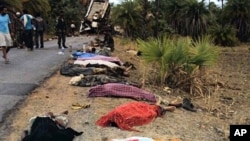
Bodies seen by roadside near the mangled wreckage of a bus which hit a landmine planted by maoist rebels in Dantewada district of Chhattisgarh, India, 17 May 2010
TEXT SIZE - +

It is being called one of the most brazen attacks on civilians by Maoists. India's government blames the rebels for planting explosives below the pavement of a rural road that destroyed a passenger bus in the central part of the country. On board were about 50 people, and authorities say most of them were killed.

The bus attack is the latest to be blamed on Maoist rebels in Chhattisgarh, a mineral-rich state.

Authorities say the bus exploded while traveling in the Dantewada district, mainly home to agricultural tribal people, in the Maoist heartland. Passengers included police and specially recruited officers, described as young tribal men who had been given some jungle warfare training to combat the rebels.

Videotape from the scene shows some of the dead wearing green camouflaged uniforms and others believed to be civilians, including at least one woman. Their bodies were thrown outside the ripped-open bus by the force of the explosion.

Home Secretary Gopal Krishna Pillai says seven seriously wounded survivors were found at the scene by rescuers and taken to a hospital.

"The bulk of the people killed were innocent unarmed civilians. And this pattern of killing unarmed civilians has been the hallmark of Maoist violence over the years," Pillai said.  

Pillai also says that earlier in the day, Maoists in another town in the same state slit the throats of six tribal villagers after accusing them of being police informers.

The Home Secretary says all "right-thinking people" – especially those human-rights activists and non-government organizations – sometimes seen as sympathetic to the cause of the rebels, should condemn such attacks.

An attack in the same forest of hardwood timber trees last month, also blamed on the Maoists, killed at least 75 policemen.

Authorities in Chhattisgarh, which is governed by the Hindu-nationalist opposition Bharatiya Janata Party, have failed to stem an increasing number of attacks by the rebels, also known as Naxalites. Some analysts blame a lack of coordination between the central government and state officials for allowing the Maoists to move about there virtually unhindered.

The four-decade insurgency, which is active in 20 of the country's 28 states, has left thousands of people dead.

Prime Minister Manmohan Singh has previously described the rebels as the biggest internal security threat faced by India.

It is being called one of the most brazen attacks on civilians by Maoists. India's government blames the rebels for planting explosives below the pavement of a rural road that destroyed a passenger bus in the central part of the country. On board were about 50 people, and authorities say most of them were killed.

The bus attack is the latest to be blamed on Maoist rebels in Chhattisgarh, a mineral-rich state.

Authorities say the bus exploded while traveling in the Dantewada district, mainly home to agricultural tribal people, in the Maoist heartland. Passengers included police and specially recruited officers, described as young tribal men who had been given some jungle warfare training to combat the rebels.

Videotape from the scene shows some of the dead wearing green camouflaged uniforms and others believed to be civilians, including at least one woman. Their bodies were thrown outside the ripped-open bus by the force of the explosion.

Home Secretary Gopal Krishna Pillai says seven seriously wounded survivors were found at the scene by rescuers and taken to a hospital.

"The bulk of the people killed were innocent unarmed civilians. And this pattern of killing unarmed civilians has been the hallmark of Maoist violence over the years," Pillai said.

Pillai also says that earlier in the day, Maoists in another town in the same state slit the throats of six tribal villagers after accusing them of being police informers.

The Home Secretary says all "right-thinking people" - especially those human-rights activists and non-government organizations - sometimes seen as sympathetic to the cause of the rebels, should condemn such attacks.

An attack in the same forest of hardwood timber trees last month, also blamed on the Maoists, killed at least 75 policemen.

Authorities in Chhattisgarh, which is governed by the Hindu-nationalist opposition Bharatiya Janata Party, have failed to stem an increasing number of attacks by the rebels, also known as Naxalites. Some analysts blame a lack of coordination between the central government and state officials for allowing the Maoists to move about there virtually unhindered.

The four-decade insurgency, which is active in 20 of the country's 28 states, has left thousands of people dead.

Prime Minister Manmohan Singh has previously described the rebels as the biggest internal security threat faced by India.


Steve Herman

A veteran journalist in Asia, Steven L Herman is the Voice of America bureau chief and correspondent based in Seoul.

You May Like

India, China Pledge to Overcome Border Tensions

Indian prime minister and Chinese premier attempt to move past tense standoff in the Himalayas during Delhi talks More

Burmese President Opens US Visit with VOA Town Hall Meeting

Ahead of his meeting with President Obama Monday, Thein Sein answered questions on human rights and economic development in his country More

Video Washington Week: Focus on Burma, US Government Scandals

President Thein Sein visits the White House on Monday, Congressional probes of multiple scandals are continuing More

This forum has been closed.
Comments
     
There are no comments in this forum. Be first and add one

Featured Videos

Your JavaScript is turned off or you have an old version of Adobe's Flash Player. Get the latest Flash player.
Video

Video Boston Bomber Spent 6 Months in Russia’s Most Violent Republic

The news of the Boston Marathon bombings circled the globe, and resonated here in Dagestan, a majority Muslim republic in Russia, on the shores of the Caspian Sea. Last year, Tamerlan Tsarnaev, the older of two brothers suspected of the bombings and a long-time Boston resident, returned to Dagestan, where he had lived for a year during his youth. Dagestan was the land of his maternal ancestors. But in the last two years, this republic of 3 million people has gained notoriety as the region with the highest level of political and religious violence in all of Russia. VOA's James Brooke reports from Makhachkala, Russia.