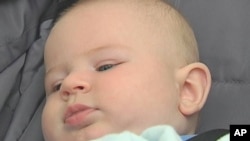
What babies know fascinates doctors, researchers and parents. With technology that can measure brain waves and other indicators, what researchers are finding is that babies know more than we suspect.
What do they know and when do they know it? Such questions have researchers monitoring babies' brains to find out.
At Northwestern University, researchers recently concluded that well before babies start to speak, they recognize words and can link them to the things they represent.
At four and a half months, Finn is not talking, but he definitely responds to what his mother says.
The Northwestern study and others indicate that one of the best things parents can do is talk to their babies.
Covington Campbell started talking to her baby even before he was born. "I spoke to Finn all the time. I sort of narrated what I was doing," Campbell said,
Researchers think babies begin developing language skills while they are in the womb. Campbell was in law school when she was pregnant with Finn. "I was finishing my last semester of law school, so, I guess, check back with me in 30 years and see if he's a litigator, because he would definitely come alive in my corporations classes and he always heard my professors speaking," she said.
Professor Kathy Hirsh-Pasik directs the Infant Language Laboratory at Temple University in Philadelphia. "We think the very first processes of language development are actually starting in the womb because they are overhearing their mother's speech," she said.
Researchers say that is when babies pick up the melodies of language. "They can sometimes remember some of the words that they've heard. And they appear to zoom in on classes of language. They may not know French from Spanish, but they know that that's in one group and English and German are in another group," Hirsh-Pasik said.
Another study shows that babies and children who are frequently talked to have higher IQ scores and later on, do better in school.
Child development specialist Judy Montgomery encourages parents to talk to their babies. "Parents and caregivers; the family members are the first ones who introduce vocabulary. And the more words the children hear, the greater their vocabulary," she said.
There are even devices that count the words babies hear to help parents gauge just how much they talk to their babies.
But Hirsh-Pasik warns against putting babies in front of a television. "Children need the interactive back-and-forth. We call it 'reciprocity,'" she said.
Campbell says she likes to sing to her baby. "He smiles a lot when we sing to him. He definitely reacts to it, it sort of calms him down a little bit," she said.
Researchers Finding Babies Smarter Than Previously Thought
- By David Dyar