



The Arab League says the withdrawal of monitors from Gulf Arab states will not hinder its work in Syria as France, Britain and Germany joined efforts at the United Nations to end President Bashar al-Assad's rule.
A league official, Adnan al-Khudeir said Wednesday a new group of observers is set to replace the 55 monitors from the Gulf Cooperation Council who left Syria Wednesday after their governments said they were certain "the bloodshed and killing of innocents would continue." He said the 15 Mauritanians, 10 Palestinians and six Egyptians will head to Syria within a week.
About 120 monitors already in Syria pledged to continue the mission, now extended until February 23, to verify Syria's compliance with an earlier Arab peace plan.
Arab League foreign ministers agreed to the latest transition plan Sunday and authorized the regional bloc's chief to seek support for it at the U.N.
Gulf Arab nations have become increasingly supportive of international action against Syria in recent weeks, as pro-Assad forces have continued attacking peaceful protesters and fighting deadly battles with army defectors.
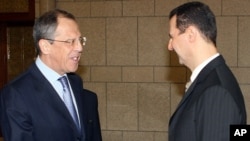
But Russia says it will not support international action on Syria that may include sanctions or military intervention. Russian Foreign Minister Sergei Lavrov said Wednesday moves by the U.N. Security Council against Syria, a long-time Russian ally, would be "unfair and counterproductive."
Moscow is a veto-wielding member of the Security Council. It joined China last October in vetoing a Western-backed resolution that would have condemned the Syrian government's violent crackdown on the revolt. Lavrov said Russia is open to what he called a "constructive" resolution on Syria that explicitly rules out any interpretation that could justify foreign military action.
Meanwhile, at least 25 UNESCO member states have joined in an attempt to remove Syria from two of the organization's committees that deal with human rights issues. Syria was named to the panels in November by UNESCO's Arab bloc. But now a number of countries - including Qatar, Kuwait, the United Arab Emirates, the United States, South Korea and European nations - are mounting a campaign to unseat Damascus.
In the latest violence on the ground, Syrian rights activists say government forces fired heavy weapons at the opposition hub of Hama late Tuesday and Wednesday, killing at least two people in the central Syrian city. They say security forces also killed at least five other civilians in attacks on centers of protest in Homs and Damascus.
Also Wednesday, the head of the Syrian Arab Red Crescent branch in the northern town of Idlib, Abdulrazak Jbero was shot dead in an attack the country's state news agency (SANA) blamed on "terrorists." An ICRC statement said he was riding in a "vehicle clearly marked with a Red Crescent emblem" and expressed shock at the killing.
The United Nations says violence linked to the uprising has killed more than 5,400 people. But U.N. human rights chief Navi Pillay said Wednesday her agency has stopped compiling a death toll for Syria's deadly crackdown because it is too difficult to get information. Pillay said some areas are totally closed, such as parts of the central city of Homs, "so we are unable to update that figure."
Syrian authorities say terrorists have killed about 2,000 security force members since the unrest began.
Some information for this report was provided by AP and AFP.
| Join the conversation on our social journalism site - Middle East Voices. Follow our Middle East reports on Twitter and discuss them on our Facebook page. |