


After 25,000 wildfires, some Russians are starting to place some of the fault on Kremlin policies and mismanagement.
Nestled in the woods, surrounded by towering pines, life in the blue trim cottage at Number One Forest Lane would be normally considered picturesque. But this summer, after weeks of drought and wildfires, Olga Kubysheva says it feels like living next to a nuclear reactor.
Kubysheva, a normally patient grandmother, is part of a growing number of Russians in the countryside and the city, who increasingly blame part of the massive fire damage on government mismanagement and lack of investment.
On Tuesday, leading business newspaper Kommersant estimated that the fire will total $15 billion in economic losses, trimming one percentage point off an already feeble economic recovery. Three public opinion polls released on Tuesday showed dropping approval ratings for Prime Minister Vladmir Putin and President Dmitri Medvedev.
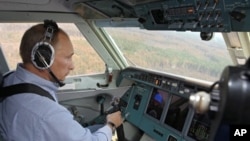
Mr. Putin responded with his usual enthusiasm. As state television cameras chronicled his exploits for the Tuesday evening news, he co-piloted an amphibious firefighting plane, taking on water from a river and dumping it on burning fires in the Ryazan Region.
"We hit it", Mr. Putin exclaimed as his plane zoomed low over the flames.
Earlier in the day, Mr. Putin met with Moscow's Mayor, Yuri Luzhkov. He acidly congratulated the mayor for his 'timely' return Sunday from a weeklong foreign vacation. While the mayor was away, city residents struggled with choking smog and extreme heat in well-insulated apartments built to withstand extreme cold.
Angering many Muscovites late last week, the mayor's press spokesman, Sergei Tsoi, told a news website that there was "no crisis situation in Moscow."
In face of sagging approval ratings, Russia's president also disciplined underlings. On Tuesday, the head of the Moscow forestry department was fired hours after Mr. Medvedev criticized him for not coming home from his summer vacation.
But Forest Lane's Kubysheva and other Russians say that government policies and mismanagement have made the country excessively vulnerable to this ongoing natural disaster.
Through Soviet times and modern times, Kubysheva has lived and worked in the forestry complex outside of Lukhovitsi, about 130 kilometers southeast of Moscow. A big change came four years ago, when Russia's new forestry law essentially privatized management of state forests. On the ground, it meant that the company laid off forest wardens to cut costs.
With the new law, she said, the forest around her has no owner. Two weeks ago, when the wildfires started, city and company authorities dismissed as alarmist Forest Lane residents who asked for protection.
After fires exploded across European Russia, burning 2,000 homes and killing 52 people, city officials sent out a work crew.
As she spoke chain saws whined next to her house. But, she said, the crew was cutting only a 30-meter firebreak, one-third the size ordered nationwide last week by Prime Minister Putin. Surrounded by 30-meter tall pines, she said she was praying for rain - and keeping her documents in her car for a quick escape.
While chains saws were cutting pine trees in the country, hammers were banging nails into pine boxes at morgues in the city on Tuesday.
The Sechenov Morgue, a Czarist-era red brick building located across the street from a Moscow city hospital, saw constant comings and goings of family groups dressed in black.
Anatoly Korenyuk, the morgue truck driver, a large man in black suspenders, fitfully tried to relax with a paperback.
The extreme heat, he said, has meant more people dying and more funerals. As he spoke, a morgue attendant interrupted, bearing a clipboard with four new addresses.
Nearby, Marina Pirozhnivona, recounted how her 86-year-old aunt died last Saturday after experiencing breathing problems on a day when wood smoke pushed city carbon monoxide to almost seven times safe levels.
She recited a long list of relatives who have left Moscow in recent days, hoping to find cleaner air and cooler temperatures.
Weather forecasters say that Moscow's smog may continue to recede on Wednesday. But they forecast little heat relief in a country where 500 forest fires were burning Tuesday.
According to Roman Vilfand, director of the Hydrometcenter weather forecast service, Moscow daytime temperatures through the weekend will continue to hit 34 degrees Celsius. He said these temperatures were more typical of the Sahara.