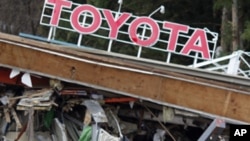
Seismologists and other scientists at eight universities in Japan are collaborating with a team of American and Russian researchers to try to devise a reliable system for predicting destructive earthquakes. This comes after the release of preliminary research following the March 11th earthquake in Japan indicating changes were detected in the atmosphere in the days before and after the destructive tremor.
When a potentially destructive earthquake strikes, the Japanese sometimes are able to receive a warning - although usually just a few seconds before the ground starts shaking.
These warnings are broadcast on radio and television and sent to mobile phones and computers. This automated alarm is triggered by the initial elastic P-wave of a tremor, which immediately precedes the slower but more destructive secondary wave, which then shakes the ground back and forth perpendicular to the direction it is moving.
Researchers around the world have been seeking a way to reliably give indications of quakes hours or days before they occur.
Some scientists are now cautiously optimistic about one theory, which they are attempting to turn into a practical warning system.
An international project exploring this path was hastily formed following the magnitude 9.0 earthquake that hit Japan three months ago. The multinational team, composed of researchers in Japan, the United States and Russia, is using satellites and other equipment to observe infrared emissions and electron activity in the atmosphere.
Interest in these phenomena grew after an analysis of atmospheric data recorded in March, above the Japanese quake’s epicenter, showing unusual changes.
Earth sciences professor Dimitar Ouzounov of Champan University (in California) is one of the scientists who analyzed the March data. He says the research still has “a long way to go” before it can be deemed to be a reliable indicator to signal earthquakes, but, if the theory is proven, the potential ramifications are obvious.
"We see as an opportunity here is that this kind of science development can produce early warnings a few days in advance," said Ouzounov. "That will have a tremendous softening impact and really can help people to survive."
For the past 20 years, scientists have speculated about a link between seismic activity and changes in the atmosphere and ionosphere.
In recent years, researchers - thanks to technological advances - have found such interesting correlations for earthquakes with magnitudes larger than 5.5 on the Richter scale and at depths of less than 50 kilometers.
Professor Ouzounov, who also is affiliated with the U.S. Goddard Space Flight Center, says among the killer tremors where these links were seen include Sichuan, China in 2008, the quake in Italy the following year and last year’s magnitude 7.0 in Haiti.
"We did it [for] about 100 earthquakes in Japan and Taiwan and the most powerful with the biggest magnitudes, of course," he said. "We have seen for all earthquakes, similar signals. This process which probably exists for all kinds of earthquakes, but the most dangerous ones, the biggest ones, are more easier to detect."
The atmospheric changes before an earthquake are believed to be triggered by the release of radon gas - which is colorless and odorless - below the surface that then ionizes and heats the surrounding air.
Some other scientists remain unconvinced. They note changes in infrared emissions and electron numbers in the upper layers of the atmosphere can be affected by cloud cover and activity from the sun. But proponents of the theory contend these other influences can be properly separated to show when they are being caused by the venting of gas from underground.
Researchers say they will be focusing the next phase of their study on Asia, because that is where most of the world’s worst earthquakes occur.
Scientists Exploring Quake Warning Signals
- By Steve Herman