




An ancient mating call from the age of the dinosaurs is back. Scientists at the University of Bristol in England have recreated the 165-million-year old love song from the fossil of a prehistoric cricket.
It was probably a noisy world, with thousands of other animal sounds, rushing streams and the rustle of giant ferns and coniferous trees.
Fernando Montealegre studies how insects sing and hear.
When he and his colleagues at the University of Bristol got their first look at a fossilized pair of katydid wings found in China, it was obvious that bug was a music maker.
Montealegre says Achaboilus musicus, as the new species was named, already displayed features that modern-day katydids use to make sound.
“One wing in extant species has a file vein, modified with a series of pegs and the other wing has a scraper. So they open and close the wing and during the closing cycle they produce the sound. The scraper hits the file teeth and generates vibrations.”
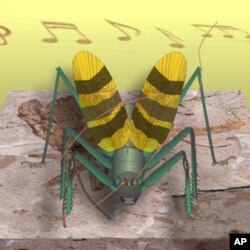
Montealegre and colleagues compared the pegs on the vein on the 7-centimeter-long katydid wings’ with those of 59 living bush cricket or katydid species. Unlike insects today that have varied rhythm and call patterns, Montealegre determined that A. musicus had a simple, single-frequency pulsing tone.
“It’s a primitive condition, just continuous singing. And in this case, the continuity would be a chirp every one second.”
The male’s low six-kilohertz tone was especially adapted to carry over long distances at night.
The mating call rose from the forest floor and captivated females, despite other Jurassic distractions. Montealegre says that sound marked a new era in acoustic evolution.
“Many animals developed these acoustic capabilities. And it was a noisy environment and so they needed to produce private channels that they would attain with pure tones and tuning the sender and the receiver at the same respective frequencies for each animal.”
But any predator that could have picked up the sound would have been a problem. Mammals may have fed on them. It wasn’t until 100 million years later that bats appeared. By that time katydids had developed ultrasonic mating calls that their enemies could not hear.
The work is reported this week in the Proceedings of the National Academy of Sciences.