U.S. scientists have done what was once considered science fiction - regrown heart muscle to replace tissue that was killed off in a heart attack. It's the latest advance in the field of regenerative medicine.
In a heart attack, the heart muscle itself loses some of its blood supply. The affected tissue dies, and the heart becomes less able to pump blood to the rest of the body.
If a patient reaches an advanced medical center quickly enough, doctors can open the blocked artery before the damage is done. But the director of the Cedars-Sinai Heart Institute in Los Angeles, Eduardo Marbán, had a more ambitious plan.
"The idea was to take patients who had suffered a heart attack, in which part of the heart muscle turns to scar, and to challenge the dogma that scar, once formed, is permanent, and that healthy tissue, once lost, is lost forever."
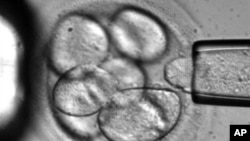
To do that, Marbán's team biopsied small pieces of heart tissue from recent heart attack victims and used them to grow stem cells in the laboratory. Millions of cardiac stem cells were then injected back into the affected part of the heart.
"So it was the same area of the heart that had sustained injury," he says, "and cells were being infused into the coronary artery that had been blocked by the clot to cause the heart attack in the first place."
Marbán reports the results of the small study, using just 25 patients, in The Lancet. The stem cell treatment cut the amount of scar tissue in half - from an average of about 24 percent of the heart to just 12 percent as measured by MRI scans a year after treatment. By comparison, a control group that didn't get stem cells had virtually no reduction in scar tissue.
Nevertheless, the stem cell patients did not register a corresponding increase in overall heart function, though they did show improvements in the particular area where new heart tissue grew back.
"And when we looked at the function at the area of the heart attack, it was pumping much better and contracting much better than in the subjects who did not receive cell therapy," Marbán says. "So by that measure, it seemed to be working, and working well."
Marbán admits this is just a "proof-of-concept" study. Further research may evaluate different ways of introducing the stem cells into patients' hearts, as well as using stem cells taken from cadaver hearts.
If the stem cell therapy proves effective, he says, the treatment could be available to heart attack patients in about four years.
Scientists Regrow Tissue Killed During Heart Attack
- By Art Chimes