



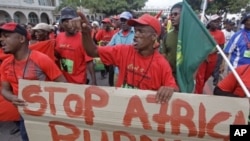
The headlines from the COP17 U.N. climate conference in Durban, South Africa have mostly underscored the deadlock on major initiatives. But there has been progress on a forestry program known as REDD+. If an agreement on the program is reached it could be one of the few success stories to emerge.
The acronym stands for Reducing Emissions from Deforestation and Degradation.
The basic theory behind the strategy is forests should be worth more when they are standing then when they are cut down.
To accomplish this goal, the REDD mechanism provides a financial value for the carbon stored in the trees. Developed countries can then invest in standing forests in developing countries to offset their own carbon emissions.
“If you can pay local communities, provide incentives, government programs for local communities to be able to keep the forests standing and still make a good livelihood off the land, but in a way that does not require them to cut the trees down, then you have a win for biodiversity, you have a win for those local communities, and you have a win for the climate," said Rane Cortez, a REDD+ advisor for the environmental group The Nature Conservancy, who works on a REDD project in Brazil.
The Nature Conservancy began working on REDD projects in the early 1990s in Latin America. Other projects have also cropped up in Asia and Africa. These projects are all based on bilateral or multilateral agreements between governments and donors, and the terms of each project vary case-by-case.
But delegates at the last U.N. climate conference in Cancun, Mexico agreed to universalize the system, establishing international safeguards and accountability measures.
Nature Conservancy climate change managing director Sarene Marshall says REDD+ is one of the few things delegates at COP17 can agree on.
“There has really been near unanimity on the issue, generally speaking," said Marshall. "Countries ranging from rainforest nations to developed countries have seen how important it is to address the forest side of emissions and to protect forests for their climate benefits and other things."
But the program is not without its detractors. A group that says it represents indigenous people around the world protested this week outside the Durban conference center, calling for a moratorium on REDD.
Indigenous Environmental Network director Tom Goldtooth says you cannot put a price on trees and earth and to create a market for nature.
“The very concept, from the indigenous perspective, it is a violation of the sacred," said Goldtooth. "What kind of people involve themselves in trading air? How do we even translate that from the deepest of our heart, to be trading air as property?"
Among the safeguards included in the draft text establishing REDD+ are protections for indigenous people.
But members of the group do not think they can trust the governments to fairly implement the programs. Kimaiyo Towett is from the Ogiek community in Kenya's Rift Valley.
“These governments are the ones that are negotiating REDD, they are already the ones preparing the proposals, negotiating with the World Bank, sending the proposal, receiving the money," said Towett. "It is the very same government now which will get a proper excuse for removing us from the forest to pave way for this program."
REDD+ remains an experiment. Even with an agreement, the architects of the program will meet regularly to adjust the terms of the program.
And while it may not be perfect, progress on REDD+ may be the biggest achievement of COP17.