



News / Asia

Shanghai Cooperation Summit Opens in Kazakhstan
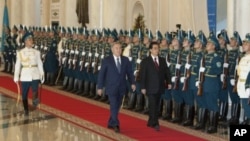
Chinese President Hu Jintao (R) and his Kazakh counterpart Nursultan Nazarbayev inspect the honour guard during an official welcoming ceremony in Astana, June 13, 2011
TEXT SIZE - +

Central and South Asian leaders sat down Wednesday for security talks with their Russian and Chinese counterparts at the annual summit of the Shanghai Cooperation Organization in Kazakhstan.

The leaders were expected to discuss expanding the core six-member group for the first time since it was founded 10 years ago. India, Pakistan and Iran all are seeking full membership in the group, which in the past has sought to limit U.S. influence in Central Asia.

Kazakhstan, Kyrgyzstan, Tajikistan and Uzbekistan already are full members of the group. Mongolia is not seeking to change its observer status.

In private talks ahead of the meeting Tuesday, Chinese President Hu Jintao urged Iranian Prime Minister Mahmoud Ahmadinejad to quickly resume talks with leading world powers about his country's nuclear program. He said Iranian steps to establish trust and promote dialogue would be in the interest not only of Iran but of the Middle East as a whole.

Ahmadinejad replied that Iran is willing to return to talks with the five permanent members of the United Nations Security Council plus Germany. But last week he rejected a report by the United Nations nuclear agency, saying it would have no bearing on Iran continuing its nuclear activities.

You May Like

Experts Weigh In on Challenges of Closing Guantanamo Prison

Former chief military prosecutor at Guantanamo delivers petition to White House with more than 370,000 signatures, demanding facility be closed down immediately More

Karzai to Discuss Enhancing Defense Ties with India

Afghanistan looking for more military aid as it prepares for withdrawal of NATO forces by next year More

India, China Pledge to Overcome Border Tensions

Indian prime minister and Chinese premier attempt to move past tense standoff in the Himalayas during Delhi talks More

Burmese President Opens US Visit with VOA Town Hall Meeting

Ahead of his meeting with President Obama Monday, Thein Sein answered questions on human rights and economic development in his country More

This forum has been closed.
Comments
     
There are no comments in this forum. Be first and add one

Featured Videos

Your JavaScript is turned off or you have an old version of Adobe's Flash Player. Get the latest Flash player.
Video

Video US Oil Surge Could Impact Mideast Geopolitics

The United States will account for a third of new oil supplies over the next five years, and will become energy self-sufficient in 20 years, according to a new report by the Paris-based International Energy Agency (IEA). Although U.S. oil imports from Arab Gulf countries increased last year, analysts predict the U.S. will lose its dependence on Middle East imports, which is expected to have a huge impact on international relations and the balance of power. VOA's Henry Ridgewell reports.