



News / USA

In Fast-Moving World, Slow-Going Barges Ply US Waterways

Barges haul about 5 percent of the nation’s bulk tonnage

A small, but mighty, tugboat pushes a barge loaded with coal up the Ohio River, past downtown Louisville, Kentucky.

Multimedia

Audio
TEXT SIZE - +
Ted Landphair

These days, words like “speed,” “flexibility,” and “high-tech” describe the American culture - and a lot of the nation’s business operations.


But not one that’s based on the nation’s inland rivers.

The companies that control the 21,000 barges that towboats and tugboats push and pull along big rivers such as the Mississippi, Ohio, and Tennessee in America’s midsection have none of those attributes.

Barges move ever so slowly - about 9.5 kilometers [6 miles] an hour. There’s not much flexibility in what they do: the rivers are where they are, and strings of 60-meter [195-foot]-long barges get to their destination in their own sweet time.
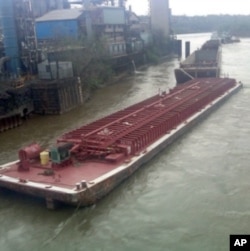
This is one of four massive barges that broke away from their towboat on the Ohio River last April. One sank.

Or late, due to floods, low water, or problems that arise in the old and creaky locks along the big rivers.

There’s a lot of waiting and patience involved in the barge business, in other words.  

About the only high-tech features involve safety onboard and coordination of delivery of coal, chemicals, and grain from their source to river ports for loading.  

Otherwise, the barges that carry about 1,700 tons of cargo apiece - 15 times the tonnage of a railcar and 40 times more than a truck can carry - are pretty much the same as they were in the 1920s.

That’s when the U.S. Army Corps of Engineers began dredging America’s large inland waterways to create deep channels to accommodate barge traffic.
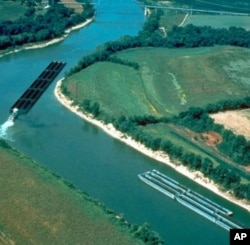
A long barge, full of coal and pushed by a tug, makes the tricky turn around one of the bends in the Cumberland River in Kentucky.

Barges haul about five percent of the nation’s bulk tonnage, and business is relatively good.

Grain production has been booming, although more and more of the nation’s corn stays put on dry land for conversion to ethanol.

And the Ohio, in particular, is still jammed with coal barges feeding coal-fired power plants along the river.

But lucrative traffic in containers arriving from overseas has mostly bypassed the rivers in favor of roads, despite the higher cost of trucks and trains. Why?  Because, unlike barge companies and captains, container shippers and their customers are in a hurry.

You May Like

Burmese President Opens US Visit with VOA Town Hall Meeting

Ahead of his meeting with President Obama Monday, Thien Sein answered questions on human rights and economic development in his country More

Video Washington Week: Focus on Burma, US Government Scandals

President Thein Sein visits the White House on Monday, Congressional probes of multiple scandals are continuing More

Indian Cinema on Mission to Dispel Bollywood Image

The largest Indian contingent to date is on the French Riviera at the Cannes film festival More

This forum has been closed.
Comments
     
There are no comments in this forum. Be first and add one

Featured Videos

Your JavaScript is turned off or you have an old version of Adobe's Flash Player. Get the latest Flash player.
Video

Video Annual Event Helps Torture Treatment Center

Once a year, an event called Big Sunday Weekend mobilizes volunteers to help at different organizations and schools. One of the places volunteers visited this year is the Program for Torture Victims, a torture treatment center in Los Angeles. The center helps survivors heal and also provides testimony to help them gain asylum in the United States. From 2010 to 2012, the Program for Torture Victims worked with close to 700 survivors from more than 65 countries. Elizabeth Lee has details from Los Angeles.