


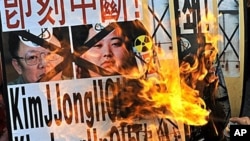
North Korea is again the "enemy" of South Korea, a designation that has not been used for six years.
The designation is given to the North in South Korea's latest defense white paper. But the document does not revive the designation of the communist state as the "main enemy." The paper also delves into details about North Korea's military capabilities.
The deputy defense minister for policy, Chang Kwang-il, explains why the label is again being applied.
Chang says this is to inform the South Korean public of the reality of North Korea and it sends a strong warning to Pyongyang.
The government, however, refrained from calling Pyongyang its "main enemy", a designation used in the 1990s.
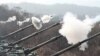
The defense ministry review, released on Thursday, details North Korea's military capabilities. It says the North has deployed large artillery guns and new, more powerful tanks near the border with the South. It also has added new elite forces trained to infiltrate the South and disrupt critical facilities.
The document says North Korea's plans to rely on its nuclear weapons, its long-range artillery, submarines, cyber-warfare and special forces to counter the South's high-technology military.
The deputy defense minister says since the last assessment, in 2008, North Korea has added 20,000 special forces troops.
Chang estimates North Korea now has 200,000 special forces soldiers, installed in light infantry units and placed on the front lines.
The report says North Korea's total force remains unchanged at 1,190,000 troops.
By comparison, South Korea has an active-duty force of 650,000. About 28,000 American troops are also stationed in the country.
The updated assessment of North Korea's military comes at the end of a year that saw tensions on the peninsula rise to their highest level in decades.
North Korea is blamed for the sinking of a South Korean navy ship in the Yellow Sea, in March. Pyongyang denies responsibility for the incident, in which 46 sailors died.
In November, North Korea shelled a South Korean island in the same waters, killing four people.
The two Koreas fought a devastating three-year war to a stalemate in the early 1950's. A truce, but no peace treaty, has been in place since then.