



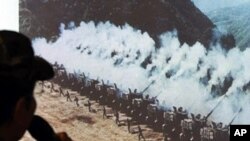
South Korean forces are embarking on a second week of live-fire drills around the nation's coasts, disregarding a warning from North Korea that the exercises could spark a nuclear war.
South Korea is also planning civil defense drills to prepare its people for the possibility of hostilities with the North. A former U.S. intelligence chief said in an interview Sunday that he expects any further provocation from the North to spark limited military clashes.
On the diplomatic front, a U.S. military delegation was in Seoul for talks Monday, while China continues to press for emergency talks between North Korea and other regional powers.
The live-fire drills are set to run Monday through Friday at 27 sites including 15 on the Yellow Sea coast where a North Korean artillery attack killed four South Koreans last month.
North Korea denounced the artillery exercises, saying they were "bringing the dark clouds of a nuclear war" to the Korean peninsula. But South Korean officials said none of the drills would take place near the contested maritime border between the two Koreas.
The South also urged citizens to pay closer than usual attention to a nationwide civil defense drill set for Wednesday afternoon. Such drills are conducted monthly, but officials said they are seeking special cooperation in light of the increased threat of hostilities.
The French news agency Agence France Presse said the drill will focus on directing citizens to the nation's thousands of underground shelters. It said about 12 jet fighters will simulate air strikes overhead.
Former U.S. intelligence chief Dennis Blair, who just completed a visit to South Korea, said in an interview that he expects clashes to break out between the two Koreas. But he said on U.S. television that he believes the fighting will be contained because North Korea knows it would lose an all-out war.
In Beijing, Foreign Minister Yang Jiechi said Sunday that China will be patient in pressing for six-way talks with North Korea to ease tensions on the peninsula. The United States, South Korea and Japan, which met in Washington last week, have been reluctant to sit down with China, Russia and North Korea until Pyongyang shows greater evidence of its sincerity.
Michael Schiffer, the U.S. deputy assistant secretary of defense, reiterated the United States' commitment to South Korea's security following a one-day meeting Monday in Seoul.
Bill Richardson, a former U.S. ambassador to the United Nations, is scheduled to arrive in Pyongyang for a private visit beginning Tuesday. Richardson is currently governor of the U.S. state of New Mexico.